August 16, 2014

1186 ROMANIA (Maramureş) - The craftsman in wood Cuza Perţa


Maramureş, the region which covers the Maramureş Depression and the surrounding Carpathian mountains, along the upper Tisa River, now divided between Romania and Ukraine, with autonomous traditions since the Middle Ages, is one of the places where traditional log building wasn't interrupted and where a rich heritage in wood survives. Its well-preserved wooden villages and churches (eight of them were designated an UNESCO World Heritage site - Wooden churches of Maramureş), its traditional lifestyle, and the local colourful dresses still in use make Maramureş as near to a living museum as can be found in Europe. Therefore, in Maramureş wooden carving was and is on a place of honor among traditional crafts. Alexandru Perţa-Cuza is the long-lasting wood craftsman in Târgu Lăpuş (do this for six decades), known among Romanians in communities around the border for his triptychs.

1185 BELARUS (Minsk City) - Minsk Passazhirsky railway station

1185 Minsk Passazhirsky railway station

Located in the centre of the capital Minsk, and sometimes called Minsk Ploshchad Lenina due to the metro station serving the terminal, Minsk Passazhirsky is the primary passenger railway station in Belarus, the hub of national passenger transport. It is also served by several international trains to various countries of Europe, mainly to Russian and Ukrainian destination. It was built in 1873 as Vilenski vakzal, Vilnius station, but the initial wooden building was demolished in 1890 and rebuilt in stone.

August 14, 2014

1183 UNITED KINGDOM (Montserrat) - The eruption of Soufrière Hills volcano


Montserrat, nicknamed The Emerald Isle of the Caribbean, is a British Overseas Territory located in the Leeward Islands, part of the chain of islands known as the Lesser Antilles, at approximately 480km east-southeast of Puerto Rico and 48km southwest of Antigua. In July 1995, Soufrière Hills volcano, a complex stratovolcano with many lava domes forming its summit, dormant for centuries, erupted and buried the island's capital, Plymouth, in more than 12m of mud, destroyed its airport and docking facilities, and rendered the southern part of the island uninhabitable. After the destruction of Plymouth and disruption of the economy, more than half of the population left the island, which lacked housing. The volcano is andesitic in nature and the current pattern of activity includes periods of dome growth, punctuated by brief episodes of dome collapse which result in pyroclastic flows, ash venting, and explosive eruption.

August 13, 2014

1182 FRANCE (New Caledonia) - A Kunie child ready to dance in Isle of Pines


New Caledonia, a special collectivity of France, consists in an archipelago located in the southwest Pacific Ocean, in Melanesia, at mid-way between Australia and New Zealand. Among its islands is the Isle of Pines (French: Île des Pins; Kanak name: Kunyié), nicknamed "l'île la plus proche du paradis" (the closest island to Paradise). The inhabitants of the island are mainly native Melanesian Kanaks and the population is 2,000 (estimated 2006). The origin of Kanak people is unclear, but ethnographic research has shown that Polynesian seafarers have intermarried with the Kanaks over the centuries.

August 12, 2014

1174-1176 UNITED NATIONS - The flag of the organisation


The United Nations (UN) is an intergovernmental organization established on 24 October 1945, after the WWII, to prevent another such conflict, actually a replacement for the ineffective League of Nations. At its founding, the UN had 51 member states, but their number grew significantly following widespread decolonization in the 1960s, so now are 193. Its objectives include maintaining international peace and security, promoting human rights, fostering social and economic development, protecting the environment, and providing humanitarian aid in cases of famine, natural disaster, and armed conflict. The UN's mission to preserve peace was complicated in its early decades by the Cold War. The organization participated in major actions in Korea and the Congo, as well as approving the creation of the state of Israel in 1947.


The flag of the UN was adopted on October 20, 1947, and consists of the official emblem of the UN in white on a blue background (white and blue are the official colours of the UN). The emblem's design is described as: "A map of the world representing an azimuthal equidistant projection centred on the North Pole, inscribed in a wreath consisting of crossed conventionalized branches of the olive tree, . . . The projection of the map extends to 60 degrees south latitude, and includes five concentric circles." The olive branches are a symbol for peace, and the world map represents all the people of the world.

August 6, 2014

ETHIOPIA (Amhara) - Rock-Hewn Churches, Lalibela (UNESCO WHS)

In a mountainous region in the heart of Ethiopia (the second country which adopted Christianity, after Armenia, in the first half of the 4th century), at Lalibela, 11 medieval monolithic churches were carved out of rock. Actually, Lalibela flourished after the decline of the Aksum Empire, and is one of Ethiopia's holiest cities, second only to Aksum, and a center of pilgrimage. Unlike Aksum, the population of Lalibela is almost completely Ethiopian Orthodox Christian.

July 31, 2014

1173 UNITED STATES (Florida) - Spaceship Earth and Monorail Peach in Epcot


The Walt Disney World Resort, or simply Disney World, is an entertainment complex in Lake Buena Vista, Florida, opened on October 1, 1971. The property covers 16,997 ha, in which it houses 24 themed resort hotels, four theme parks, two water parks, four golf courses, and numerous additional recreational and entertainment venues. Magic Kingdom was the first and original theme park to open in the complex followed by Epcot, Disney's Hollywood Studios, and Disney's Animal Kingdom, opened later throughout the 1980s and 1990s. Epcot (an acronym for Experimental Prototype Community of Tomorrow), the second of theme parks, spans 120 ha, more than twice the size of the Magic Kingdom park. Dedicated to the celebration of human achievement, namely technological innovation and international culture, is often referred to as a "Permanent World's Fair."

July 30, 2014

1171 JORDAN - Jerash Archaeological City (UNESCO WHS - Tentative List)


Situated in the north of Jordan, 48km north of the capital Amman towards Syria, Jerash is the site of the ruins of the Greco-Roman city of Gerasa, also referred to as Antioch on the Golden River. Ancient inscriptions establish the foundation of the city as being by Alexander the Great or his general Perdiccas. It was a city of the Decapolis (Ten Cities), a group of ten cities on the eastern frontier of the Roman Empire in Jordan, Israel and Syria. Recent excavations show that Jerash was already inhabited during the Bronze Age (3200 BC - 1200 BC). The Romans, who conquest the city in 63 BC, ensured security and peace in this area, which enabled its people to devote their efforts to economic development and encouraged civic building activity. The Persian invasion in 614 caused the rapid decline of Jerash, and in 749 a major earthquake destroyed much of the city. During the period of the Crusades, some of the monuments were converted to fortresses. Small settlements continued in Jerash during the Ayyubid, Mameluk and Ottoman periods.

July 29, 2014

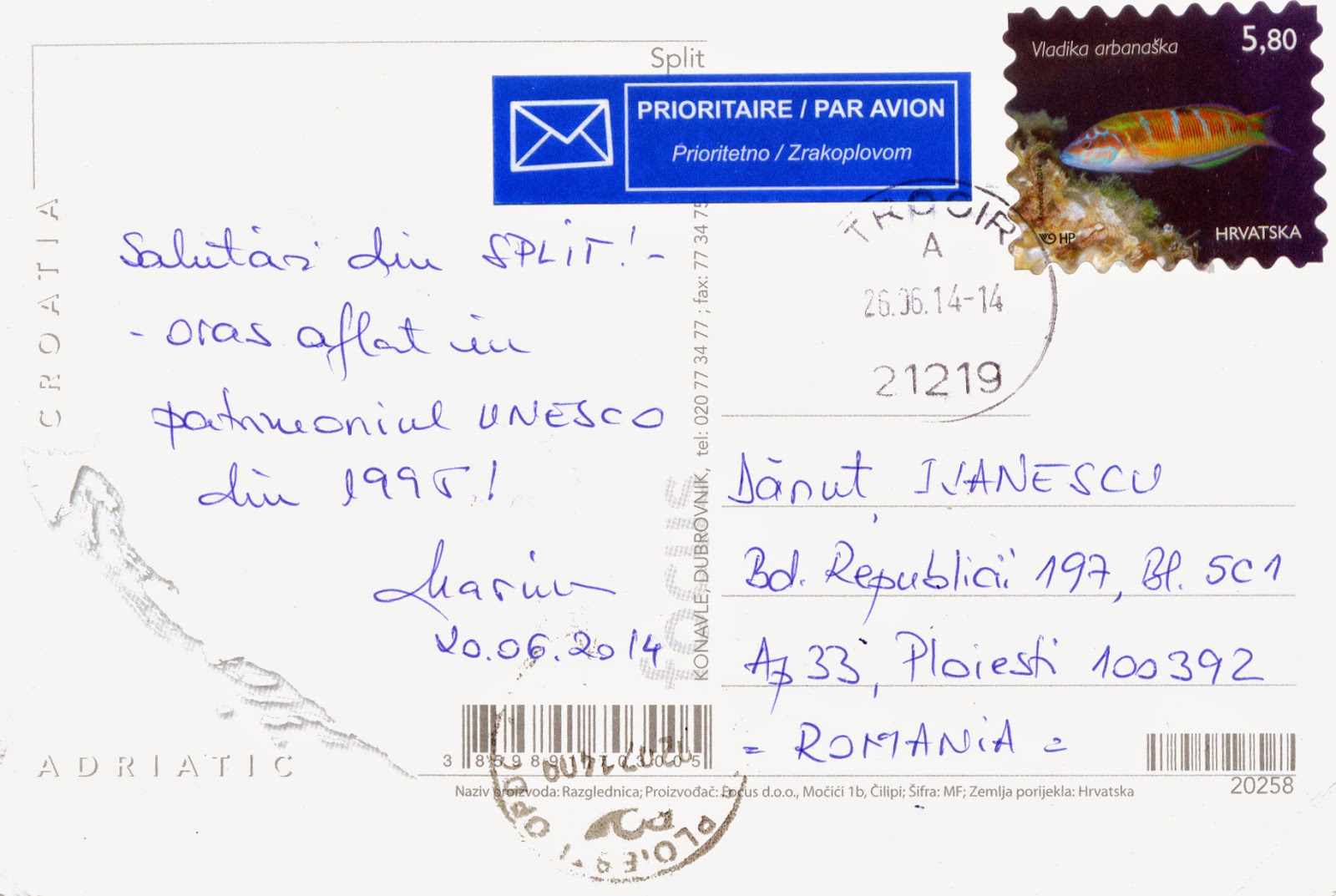
0733, 0734, 1136, 1170 CROATIA (Split-Dalmatia) - Historical Complex of Split with the Palace of Diocletian (UNESCO WHS)


Posted on 11.07.2013, 09.07.2014, and 29.07.2014
It is said that the Diocletian's Palace is placed on the center of the city of Split. For the sake of accuracy, I must say that in fact the city was built around the palace. It was began in 293 AD, and was finished in 305, right on time to receive its owner, who retired there, becoming the first Roman Emperor to voluntarily remove himself from office. He will enjoy only 6 years by the pleasures offered by the opulent refuge, because he committed suicide in 311. After the Romans abandoned the site, the palace remained empty until the 7th century, when nearby residents fled to the walled palace to escape invading barbarians, and so was born the current city. After the Middle Ages the palace was unknown in the West until the Scottish neo-classical architect Robert Adam discovered the ruins in 18th century.


As can be seen in the first postcard, a reconstruction of the palace in its original appearance, made by the French architect and archaeologist Ernest Hébrard in 1912, the ground plan of the assembly is an irregular rectangle (approximately 160m x 190m), with towers on three sides. The palace is enclosed by walls, and at times, it housed over 9000 people. Only the southern facade, the one seaward, was unfortified. The palace combines therefore the qualities of a luxurious villa with those of a military camp. A monumental gate in the middle of each of the walls led to an enclosed courtyard. The southern sea gate (the Porta Aenea) was simpler in shape and dimensions than the other three. The transverse road (decumanus) linking the eastern gate (the Silver Gate or Porta Argentea) and western gate (the Iron Gate or Porta Ferrea) divided the complex into two-halves.


A monumental court, called the Peristyle, formed the northern access to the imperial apartments. It also gave access to Diocletian's mausoleum on the east (now Cathedral of St. Domnius), and to three temples on the west (two of which are now lost, the third having become a baptistery, originally being the temple of Jupiter). The northern half of the palace, divided in two parts by the main north-south street (cardo) leading from the Golden Gate (Porta Aurea) to the Peristyle, is less well preserved. The palace was built of white local limestone, marble of high quality, tuff and brick, and was decorated with numerous 3500 year old granite sphinxes, originating from the site of Egyptian Pharaoh Thutmose III. Only three have survived the centuries. In the left is the Bell Tower, constructed in the year 1100 AD, in the Romanesque style, the city's main symbol.


The Cathedral of St. Domnius, known locally as the Sveti Dujam, is the Catholic cathedral in Split, actually a complex of a church and a bell tower. Strictly the church is dedicated to the Virgin Mary, and the bell tower to Saint Duje. The cathedral, consecrated at the turn of the 7th century, is regarded as one of the oldest Catholic cathedral in the world that remains in use in its original structure. The structure itself, built in 305 as the Mausoleum of Diocletian, is the second oldest structure used by any Christian Cathedral. The Bell Tower was constructed in the year 1100, in the Romanesque style.

1169 MONGOLIA (Ulaanbaatar) - The statue of Sükhbaatar in Ulaanbaatar


The central square of Ulaanbaatar, the capital city of Mongolia, is Sükhbaatar Square, named after the equestrian statue of Damdin Sükhbaatar, located directly in front of the Saaral Ordon (Government Palace). Sükhbaatar (literally meaning "Axe hero") was a founding member of the Mongolian People's Party and leader of the Mongolian partisan army that liberated Khüree (then called Ulaanbaatar) during the Outer Mongolian Revolution of 1921. Enshrined as the "Father of Mongolia's Revolution", he is remembered as one of the most important figures in Mongolia's struggle for independence. He had close relations with the last Khaan of Mongolia, Bogd Gegeen, and didn't intend to spread Bolshevik ideas in Mongolia. Therefore, his death at only 30 years old aroused suspicion. The words he apparently proclaimed at the time are engraved on the bottom of the statue: "If we, the whole people, unite in our common effort and common will, there will be nothing in the world that we cannot achieve, that we will not have learnt or failed to do."

July 28, 2014

1168 UNITED ARAB EMIRATES - Traditional arabian horse rider


Admired and desired, immortalised by pen and brush, the Arabian horse had, arguably, more influence on civilisation than any other equine breed. The nomadic Bedouin were the first who tame the wild Arabian, but they treated it as a friend and ally rather than a beast of burden. The camel was a means of survival, providing meat, milk, leather and transportation on the long treks across the desert sands.

July 27, 2014

1167 BULGARIA (Blagoevgrad) - A woman from Gotse Delchev with traditional headdress


I wrote here a little about the bulgarian traditional clothes, and about the main bulgarian ethnographic regions, so I don't insist for now. The woman in the postcard is from Gotse Delchev, in the south-west of the country. Prior to the 20th century, for weddings the hair was arranged in complex styles formed with multiple plaits; in the north and southwest, brides wore a specific headband made of decorative metal chains forming a crown. Married women covered their heads with scarves of colored silk or cotton (which could be square, triangular or rectangular, small or large), sometimes worn over a small hat. Bridal headdresses usually had a large square headscarf or scarf (mesal) 2m to 3m long and decorated with embroidery and long fringes on both ends. The headscarf was worn over cylinder or cone shape low hats. It were folded in the middle and placed on head, or could be worn over a pad, with the ends hanging loose at back. The style of jewelry worn with Bulgarian ethnic dress was strongly influenced by Ottoman fashions but with certain ancient elements, such as the over-the-ear pendants. During the period of national revival, workshops in the prosperous towns made earrings, bracelets, necklaces, and rings of silver filigree or cast copper or silver, often decorated with enamel.

1163-1166 NETHERLANDS (Aruba) - California Lighthouse


Located near Arashi Beach on the northwest tip of Aruba, in the area known as Hudishibana, California Lighthouse was named for the British wooden steamship California, which wrecked nearby on September 23, 1891, after sailing from Liverpool toward Central America. On board, passengers were partying hard when the wreck occurred. Meanwhile, the crew was more practical, tossing cargo overboard as the sinking vessel hit the coast so the merchandise could be sold in Oranjestad - or so the story goes.


Two decades later, a French architect designed the striking edifice that came to be known as the California Lighthouse. Construction on the lighthouse began in 1914 and took two years to complete. The tower was built using stone blocks quarried in the area. Meanwhile, the top - which stands at 30m high - was made of metal to house the mood-altering light that shines onto the landscape today. It is conical, but has an octagonal base and it is unpainted (sand coloured). Around the lighthouse are acres of stoned-filled flat land, and a area called California White Sand Dunes.


It was formerly open to the public until a suicide occurred, which prompted authorities to restrict public access to the lighthouse. Now it is a major tourist attraction, because any time of day or night is a great time to visit the lighthouse for a 360 degree view, but the sunset is hands down the right time of day to be there as the big orange ball of fire gently dips into the Caribbean Sea. Right next to the California Lighthouse is a very good Italian restaurant named La Trattoria El Faro Blanco (The White Lighthouse Restaurant).


July 26, 2014

1162 UNITED STATES (Georgia) - Georgia map


Located in the southeastern United States, on the shore of the Atlantic Ocean, between Florida, South Carolina, Alabama, Tennessee and North Carolina, Georgia, also known as Peach State, was established in 1732, the last of the original Thirteen Colonies. Named after King George II of Great Britain, it was the fourth state to ratify the U.S. Constitution, but also one of the original seven Confederate states, and the last one to be restored to the Union, on July 15, 1870. The state's capital and its most populous city is Atlanta, built in 1840 as Terminus, the "zero milepost" of  Western and Atlantic Railroad. The northern part of the state is in the Blue Ridge Mountains, a mountain range in the Appalachian Mountain system. The central Piedmont extends from the foothills to the fall line, where the rivers cascade down in elevation to the continental coastal plain of the southern part of the state. If Georgia were a stand-alone country, it would be the 28th largest economy in the world. The state symbols are Brown Thrasher, Cherokee Rose and White Oak, its motto is "Wisdom, Justice, and Moderation", and its song is Georgia on my mind.

July 25, 2014

1161 BANGLADESH (Dhaka) - National Martyrs' Memorial in Savar

1161 National Martyrs' Memorial in Savar

Located at about 35km northwest of Dhaka, the capital city of the country, Jatiyo Smriti Soudho, the National Monument for the Martyrs of the Bangladesh Liberation War of 1971 (which brought independence and separated Bangladesh from Pakistan) was designed by Syed Mainul Hossain and inaugurated at 16 December, 1982. The monument is composed of 7 isosceles triangular pyramid shaped structures, with the middle one being the tallest. The highest point of the monument is 50m. There is an artificial lake, and several mass graves in front of the main monument. From the main gate one can see the monument axially, but to reach there one has to walk through different levels of red pavements and cross a lake - all these representing the struggle for independence.

1160 CAMBODIA (Siem Reap) - Traditional Apsara dancer


Apsaras are female spirits of the clouds and waters in Hindu and Buddhist mythology, assimilated to some extent with nymphs from european mythology. They are youthful and elegant, and superb in the art of dancing, being associated with fertility rites. They are often the wives of the Gandharvas, the court musicians of Indra. They dance to the music made by the Gandharvas, usually in the palaces of the gods, entertain and sometimes seduce gods and men. They are said to be able to change their shape at will, and rule over the fortunes of gaming and gambling. Apsaras represent an important motif in the stone bas-reliefs of the Angkorian temples in Cambodia, about which I wrote here.

July 23, 2014

1159 FRANCE (Martinique) - Woman dressed into traditional Creole clothes in Martinique


Located in Lesser Antilles in the eastern Caribbean Sea, Martinique, as also Guadeloupe, is an overseas region of France, so its culture blends French and Caribbean influences. The city of Saint-Pierre was often referred to as the "Paris of the Lesser Antilles". Most of Martinique's population is descended from enslaved Africans brought to work on sugar plantations during the colonial era, generally mixed with some French, Amerindian (Carib people), Indian (Tamil), Lebanese or Chinese ancestry. Many Martinicans speak, in addition to French (official), Martiniquan Creole, a subdivision of Antillean Creole that is virtually identical to the varieties spoken in Saint Lucia and Dominica.

July 22, 2014

1158 MADAGASCAR - Les baobabs amoureux in Morondava


Once upon a time, a young man and a young woman of two nearby villages fell in love from each other. Unfortunately both had already an assigned partner and had to marry separately in their respective villages. However, the impossible couple dreamed of a common eternity life and having a child together and secretly asked help to their god. Both baobabs were born and now live they for eternity as one as the couple always wished. So says the legend that appeared the two baobabs known as Les baobabs amoureux (the Lovers baobabs), located at 7km to the northwest of the famous Avenue or Alley of the Baobabs, a prominent group of baobab trees lining the dirt road between Morondava and Belon'i Tsiribihina in the Menabe region in western Madagascar. Along the 260m of the avenue are 20-25 trees about 30m in height, known locally as renala (Malagasy for "mother of the forest"), a legacy of the dense tropical forests that once thrived on Madagascar.

July 21, 2014

1157 POLAND - The map and the flag of the country


Located between Germany, the Czech Republic, Slovakia, Ukraine, Belarus, Kaliningrad Oblast (a Russian exclave) and Lithuania, Poland is an almost unbroken plain reaching from the Baltic Sea in the north, to the Sudetes and Carpathian Mountains in the south. Within that plain, terrain variations run in bands east to west. The Baltic coast has two natural harbors (Gdańsk Bay and Bay of Pomerania), and the northeastern region, with more than 2,000 lakes, is densely wooded and sparsely populated. Its capital and largest city is Warsaw, established on the Vistula River at about 1300 by the Płock prince Bolesław II of Masovia, known as the city of palaces, royal gardens and grand parks.