Showing posts with label SPAIN (Andalusia). Show all posts

January 28, 2018

3251 SPAIN (Andalusia) - Salobreña


Located in Granada, on the Costa Tropical, Salobreña claims a history stretching back 6,000 years. The Old Town which sits atop a rocky prominence (Gran Peñón) and is a cluster of whitewashed houses and quirky steep narrow streets leading up to a 10th-century Moorish castle. Another interesting building is the parish church of Nuestra Señora del Rosario, built in the 16th century on the site of an old mosque. The different districts of the town, like La Loma, La Fuente, El Brocal and el Albaycín, have medieval corners with openings for doors, arches and windows.

December 14, 2015

2123 SPAIN (Andalusia) - Costa del Sol


Tourist destination of world renown, the Costa del Sol (Sun Coast) is a region in the south of Spain, comprising the coastal towns and communities along the coastline of the Province of Málaga, between lesser known the Costa de la Luz and the Costa Tropical. It includes the city of Málaga and also the towns of Torremolinos, Benalmádena, Fuengirola, Mijas, Marbella, San Pedro de Alcántara, Estepona, Manilva, Casares, Rincón de la Victoria, Vélez-Málaga, Nerja, Frigiliana and Torrox.

September 18, 2015

1903 SPAIN (Andalusia) - Marbella, on Costa del Sol


Situated on the Mediterranean Sea, between Málaga and the Gibraltar Strait, in the foothills of the Sierra Blanca, Marbella is one of the most important tourist cities of the Costa del Sol and throughout most of the year is an international tourist attraction, due mainly to its climate and tourist infrastructure. The city also has a significant archaeological heritage, several museums and performance spaces, and a cultural calendar. In addition, the historic part of the city shelters lovely corners of a typically Andalusian flavour, with whitewashed houses and orange trees adorning the streets and squares.

February 3, 2014

1002 SPAIN (Andalusia) - La Alcazaba in Málaga


Located on the Costa del Sol (Coast of the Sun) of the Mediterranean, at about 100 km east of the Strait of Gibraltar and about 130 km north of Africa, Málaga enjoys a subtropical-mediterranean climate and has a history of about three millennia. Founded by the Phoenicians, reached under the hegemony of Ancient Carthage, then was ruled by the Roman Republic and later the Roman Empire. After the fall of the empire, it was ruled first by the Visigoths and then by the Byzantine Empire, and in the 8th century was conquered by Moors, as most part of the Iberian Peninsula. In 1487 it again came under Christian rule in the Reconquista.

January 25, 2014

0988 SPAIN (Andalusia) - The map of Andalusia


Even if Spain is a highly decentralized state, being composed, in terms of administrative, by 17 autonomous communities and 2 autonomous cities, is, in accordance with the constitution of 1978, a unitary state, not a federation. In other words, the Spanish nation is the common and indivisible homeland of all Spaniards, which is integrated by nationalities and regions to which the constitution recognizes and guarantees the right to self-government.

January 23, 2014

0985, 0986 SPAIN (Andalusia) - Alhambra - part of Alhambra, Generalife and Albayzín, Granada (UNESCO WHS)

0985 Panorama of the Alhambra

Although the area was inhabited from at least the 8th century B.C., the actual founding of present day Granada, at the foot of the Sierra Nevada mountains, at the confluence of four rivers (the Beiro, the Darro, the Genil and the Monachil), took place in the 11th century, during a civil war that ended the Caliphate. In a short time this village was transformed into one of the most important cities of Al-Andalus, spreading across the Darro to reach the hill of the future Alhambra, and included the Albayzín neighborhood.

0986 Alhambra -Ornamental works in stucco and azulejos
 

With the Reconquista in full swing after the conquest of Cordoba in 1236, the Nasrids aligned themselves with Ferdinand III of Castile, officially becoming the Emirate of Granada in 1238. In 1492, the last Muslim ruler in Iberia, Emir Muhammad XII, surrendered complete control of the Emirate of Granada to Ferdinand II and Isabella I, Los Reyes Católicos (The Catholic Monarchs), after the last battle of the Granada War. Actually the fall of Granada completed the Reconquista, putting an end to the 800 year-long Islamic rule in the Iberian Peninsula.

January 10, 2014

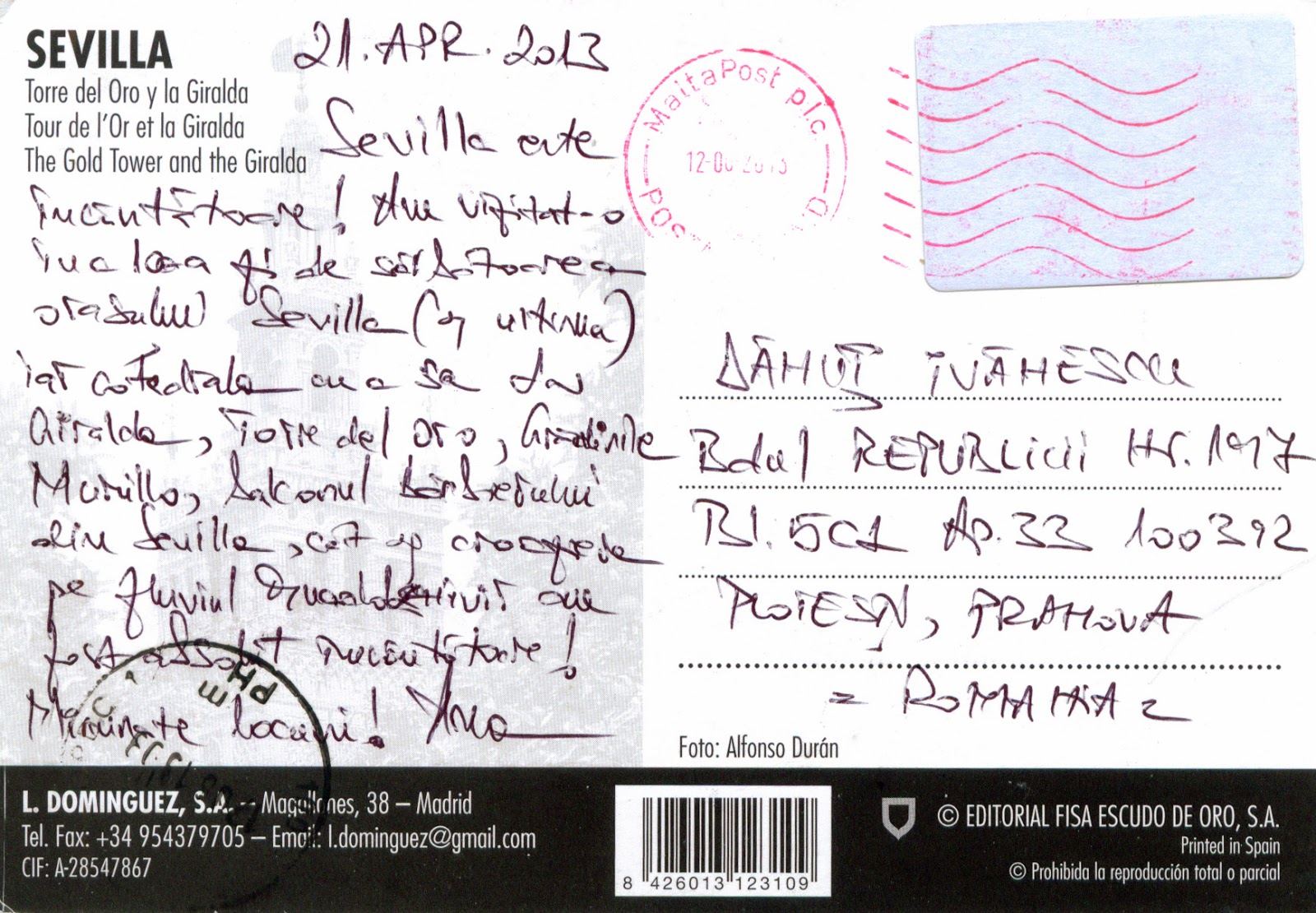
0959, 0960 SPAIN (Andalusia) - Cathedral, Alcázar and General Archive of the Indies in Seville (UNESCO WHS)

0959 Seville - Aerial view of the Cathedral
and The General Archive of the Indies

Situated in the fertile valley of the Guadalquivir, on the both banks of the river, Seville is approximately 2,200 years old, and the passage of the various civilisations has left it with a distinct personality. The mythological founder of the city is Hercules, but in reality was founded as the Roman city of Hispalis. Conquered by the Vandals and the Visigoths during the 5th and 6th centuries, in 712 it reached into the hands of the Moors, who have named it Ishbiliya.

0960 Seville - The Gold Tower and the Giralda

After more than five centuries of Muslim rule, in 1248 Ferdinand III incorporated it into the Christian Kingdom of Castile. The discovery of the Americas transformed it in one of the economic centres of the Spanish Empire, as its port monopolised the trans-oceanic trade. Coinciding with the Baroque period, the 17th century represented the most brilliant flowering of the city's culture, but then began a gradual economic and demographic decline. Its Old Town, very well preserved, is the third largest in Europe. Cathedral, Alcázar and General Archive of the Indies form a remarkable monumental complex in the heart of the city.

July 11, 2013

0732, 0733 SPAIN (Andalusia) - Historic Centre of Córdoba (UNESCO WHS)

0732 The Roman Bridge over the Guadalquivir and
the Mosque-Cathedral of Córdoba

Located on the banks of the Guadalquivir river, Córdoba was mentioned for the first time in relation with the Carthaginian general Hamilcar Barca (father of Hannibal), who renamed the settlement Kartuba, from Kart-Juba ("the City of Juba", a Numidian commander who had died in a battle nearby). In Roman times, but also under Byzantine Empire, and under the Visigoths, it was an important city, but it experienced its golden period under the Moors. Conquered in 711 by a Muslim army, it become firstly the capital of the independent Muslim emirate of al-Andalus, later a Caliphate itself.

0733 Interior of Mosque-Cathedral of Córdoba

During the caliphate apogee (1000 AD), Córdoba was one of the the most populous and advanced cities in the world, as well as a great cultural, political, financial and economic centre. In the next centuries it fell into a steady decline, continued also after it was captured by King Ferdinand III of Castile, during the Spanish Reconquista (1236), only in the 20th century knowing a certain recovery. Today, Córdoba has the second largest Old town in Europe, the largest urban area in the world declared World Heritage Site by UNESCO (in 1984, with extension in 1994).

July 6, 2013

0721 SPAIN (Andalusia) - Tarifa


Located on the Costa de la Luz (Coast of Light), across the Straits of Gibraltar, Tarifa is the southernmost point of the European continent, situated south of the African capital cities of Tunis and Algiers. As Ana say, from here started Arabs the conquest of the Visigothic Hispania. In July 710 AD, the Umayyad general Tariq ibn Ziyad sent one of his commanders, Tarif ibn Malik, on a raid to test the southern coastline of the Iberian peninsula.

March 3, 2013

0537, 0538 SPAIN (Andalusia) - Renaissance Monumental Ensembles of Úbeda and Baeza (UNESCO WHS)

0537 The Former Cathedral of Baeza

Úbeda and Baeza are two small towns, some 10 km from each other, located on the northern slopes of the valley of the Guadalquivir River, between the regions of Castile and Andalusia. After the Moorish conquest from the 8th century, they became fortresses, and were recovered by the Christians in the first half of the 13th century. Both towns prospered for a time in the 16th century, due to the production of textiles. They are an exceptional example of the distribution of urban functions, so that the sum of the monumental site of Baeza (public, ecclesiastic and educational) and of Úbeda (aristocratic and palaces) make up a complete Renaissance urban scheme of high architectural quality.

0538 El Salvador Chapel in Úbeda

The 16th-century examples of architectural and urban design in Úbeda and Baeza were instrumental in introducing the Italian Renaissance ideas to Spain (even if their origins had been in the Islamic period), and through the publications of Andrés de Vandelvira, the principal project architect, these examples were diffused to Latin America. The dominant reference point in Baeza is the Cathedral of the Nativity of Our Lady, built above a former Moorish mosque, converted to the Christian rite by King Alfonso VII of Castile in 1147, become again mosque and restored one more time to Christianity in 1227 by Ferdinand III of Castile.

0536 SPAIN (Andalusia) - The Pastira from Jaén


Its position in the extreme south of Iberian Peninsula, providing a gateway between Europe and Africa, added to its position between the Atlantic Ocean and the Mediterranean Sea, have made Andalusia a tempting prize, so the region's history and culture have been influenced by the earlier Iberians, Phoenicians, Carthaginians, Greeks, Romans, Vandals, Visigoths, Byzantines, and of course, the Moors and the Sephardi Jews, as well as the Christian North Iberian nationalities who repopulated the area in the latter phases of the Reconquista. It contains eight distinct provinces, all with individual cultural traditions and identity.