March 7, 2014

1026 NORWAY (Vestland) - Urnes Stave Church (UNESCO WHS)


A stave church is a medieval wooden Christian church, named so due to its structure of poles and lintels, the load-bearing posts being called stafr in Old Norse and stav in Norwegian. Once common all over northwestern Europe (probably more than 1,300 were only in Norway), until today survived very few, most of them in Norway. Actually, only two medieval stave churches remained outside Norway: one in Sweden (Hedared), and one in Poland (Karpacz - relocated in 1842 from Norway). Of the 28 stave churches in Norway, one was listed as a World Heritage Site by UNESCO (in 1979): Urnes Stave Church, probably the oldest of its kind, built around 1130.

March 6, 2014

1024-1025 GREECE (Central Macedonia) - Paleochristian and Byzantine monuments of Thessaloniki (UNESCO WHS)


Founded around 315 BC by the King Cassander of Macedon (son of Antipater, one of the great generals of Philip II and Alexander the Great), on or near the site of the ancient town of Therma and 26 other villages, and named after his wife, a half-sister of Alexander the Great, Thessaloniki (from Thessalos - Thessalian, and nike - victory) evolved to become the most important city in Macedon, then an flourishing free city of the Roman Republic, and finally the co-reigning city of the Byzantine Empire, alongside Constantinople. Due to its importance during the early Christian period, but also later, the city is host to several monuments, constructed from the 4th to the 15th century, which constitute a diachronic typological series, with considerable influence in the Byzantine world. In 1988, 15 of these monuments of Thessaloniki were listed as UNESCO World Heritage Sites.


The Rotunda of Galerius (in the first postcard), also known as the Greek Orthodox Church of Agios Georgios, is a cylindrical structure with a diameter of 24.5m, built in 306 AD on the orders of the tetrarch Galerius, and intended to be his mausoleum. Its walls are more than 6m thick, which is why it has withstood Thessaloniki's earthquakes. A flat brick dome, 30m high at the peak, which in its original design had an oculus (a circular opening in the centre), crowns the structure. The Emperor Constantine I converted the building in church in the 4th century, adorning it with very high quality mosaics, from which fragments have survived till today. In 1590 it was converted into mosque by the conquerors Ottomans, but in 1912 was reconsecrated as church.

March 3, 2014

1021 CANADA (Ontario) - Ontario Legislative Building in Toronto


Located in Queen's Park, on that part south of Wellesley Street which is the former site of King's College (later the University of Toronto), and which is leased from the university by the provincial Crown for a "peppercorn" payment of CAD$1 per annum on a 999 year term, the Ontario Legislative Building houses the viceregal suite of the Lieutenant Governor of Ontario, the Legislative Assembly of Ontario, and offices for members of the provincial parliament. As is known, Canada is a constitutional monarchy, in which head of state is the Monarch (since February 6, 1952 Elizabeth II, the Queen of Canada), so the Lieutenant Governor of Ontario is the viceregal representative in Ontario of the monarch.

March 2, 2014

1020 POLAND (Holy Cross) - Krzyżtopór Palace


Built by Krzysztof Ossoliński (1587-1645), a Polish nobleman and Voivode of Sandomierz, this castle, located in the village of Ujazd, in southern Poland, was partially destroyed during the Swedish invasion in 1655, and then reduced to ruin during the war of the Bar Confederation by the Russians in 1770. During the WWII  the complex was again ransacked. A partial remodeling took place in 1971, and in 1980 the Polish Ministry of Internal Affairs decided to rebuild it for use as a rest area for officers. This work was halted in 1981, when martial law was imposed in Poland.

February 26, 2014

1015 NETHERLANDS (Netherlands / Bonaire) - The main street of Kralendijk


Located in Carribean Sea, at only 80km north of Venezuelan coast, and 48km est of  Curaçao, Bonaire is a island that, together with the uninhabited islet of Klein Bonaire, forms a special municipality of the Netherlands, as also Sint Eustatius and Saba. Actually the three form the Caribbean Netherlands, known also as the BES islands. As an aside, in the Carribean Sea are located other three islands under Dutch sovereignty, but which are constituent countries of the Kingdom of the Netherlands (namely are equal in status with The Netherlands, as partners within the kingdom): Aruba, Curaçao, and Sint Maarten. All six islands are named Dutch Caribbean, and formed the Netherlands Antilles until the country's dissolution on 10 October 2010.

February 24, 2014

1013 CROATIA (Zagreb) - Croatian National Theatre in Zagreb


As the largest city of Croatia, Zagreb occupy, of course, leading economic position in the country, making it a global and cosmopolitan metropolis. This thing, but mostly its status as the capital, its history and its cultural tradition, are all reasons to consider it not only an important centre of Croatian culture, but also of Europe and the world. In addition to museums, galleries, schools and places of worship, there are about 20 permanent or seasonal theaters and stages in Zagreb, the most important being the Croatian National Theater, built in 1895 and opened by emperor Franz Joseph I of Austria.

February 23, 2014

1011 ESTONIA (Saare) - Traditional clothes in Jämaja


Estonians are a Finnic people and have strong ties to the Nordic countries, stemming from important cultural and religious influences gained over centuries during Scandinavian and German rule and settlement. Even so, Estonian traditional costumes have a lot in common with the ones of Latvians and Lithuanians, and are divided into four main groups, which have their origins to the ancient tribal differences: Southern, Northern, Western Estonia, and the Islands. On the other hand, as in many other ethnic groups, both everyday and festive clothing constitute a complicated system of signs, referring to the wearer’s national belonging, social status, age and marital status. Actually today each parish has its own traditional clothing, developed between 17th and 19th centuries.

February 22, 2014

1010 JAPAN (Chūbu) - Tateyama Kurobe Alpine Route


The Tateyama Kurobe Alpine Route, known also as the "Roof of Japan", is a famous mountain sightseeing route between the cities Tateyama and Ōmachi, in the center of the island of Honshu. The route, opened in 1971, is just 37km in length, but the vertical interval is as large as 1,975m. The route is carefully built so that the surrounding environment is not damaged. Consequently, three lines go entirely under tunnels. Among them, two are trolleybus lines, the only ones in use in Japan. The route goes through Tateyama in the Hida Mountains with a lot of scenic sites, including Kurobe dam. Currently, the route is purely a sightseeing one, only used by tourists, especially that the Tateyama Kurobe area is a national park with protected flora and fauna.

February 20, 2014

1007-1008 INDONESIA (Java) - The Olden Days Indonesia


"The Olden Days Indonesia" is a series comprising wonderful reproductions of postcards issued at the beginning of the 20th century. The couple shown in the first of these was immortalized, undoubtedly, with a special occasion. On the original, published by J. art shop Sigrist from Jogja (today Yogyakarta), is written "Javaansche Bruid en Bruidegom - Temanten laki en prampoean di poelo Djawa" (i.e. "Bride and groom in Java"). Actually the photo don't show an ordinary bridal couple - even if, as far as I know, the two were not identified (nor the photographer) - but a patrician one, and this thing is proven by the clothes, a typical kraton (royal palace) wedding dress of Yogyakarta.

Both of them wears a gold bracelet on arm, with a dragon head. Ornament worn on the chest is a gold necklace with a three objects, called calendar. The ear jewelry, sumping, are shaped like wings and leather images are painted with golden color. The hat worn by the groom, kuluk, is made of glass. Batik patterns are used quite unique as well . The bride is dressed in dodotan (Javanese traditional clothes of batik) and bun bokornya as motif headdress, with a special frilly headdress cassowary feathers, decorated with flowers and jebehan bight.


In the second postcard is a wayang orang performance in the same city, in 1920. Wayang (which means shadow) is a Javanese word for particular kinds of theatre. About wayang kulit, or shadow puppets, I wrote here. Wayang wong (in Javanese), or wayang orang (in Indonesian - literally means "human wayang") is a type of unmasked dance theatrical performance, with themes taken from episode of Ramayana or Mahabharata. Performances are stylised, reflecting Javanese court culture. Garrett Kam, a Hawaii-based teacher and performer of Javanese dance, wrote in a article in 1982: "Wayang wong dance drama in the central Javanese Kraton (royal court) of Yogyakarta represents the epitome of Javanese aesthetic unity. It is total theatre involving dance, drama, music, visual arts, language, and literature. A highly cultured sense of formality permeates every aspect of its presentation". Originally, it was performed only as an aristocratic entertainment in palaces of Yogyakarta and Surakarta, the first court dance drama, Gondorwedoyo (Scent of the Heart), being presented under the personal direction of Hamengku Buwana I in the 18th century. In the course of time, it spread to become a popular and folk form as well.

February 17, 2014

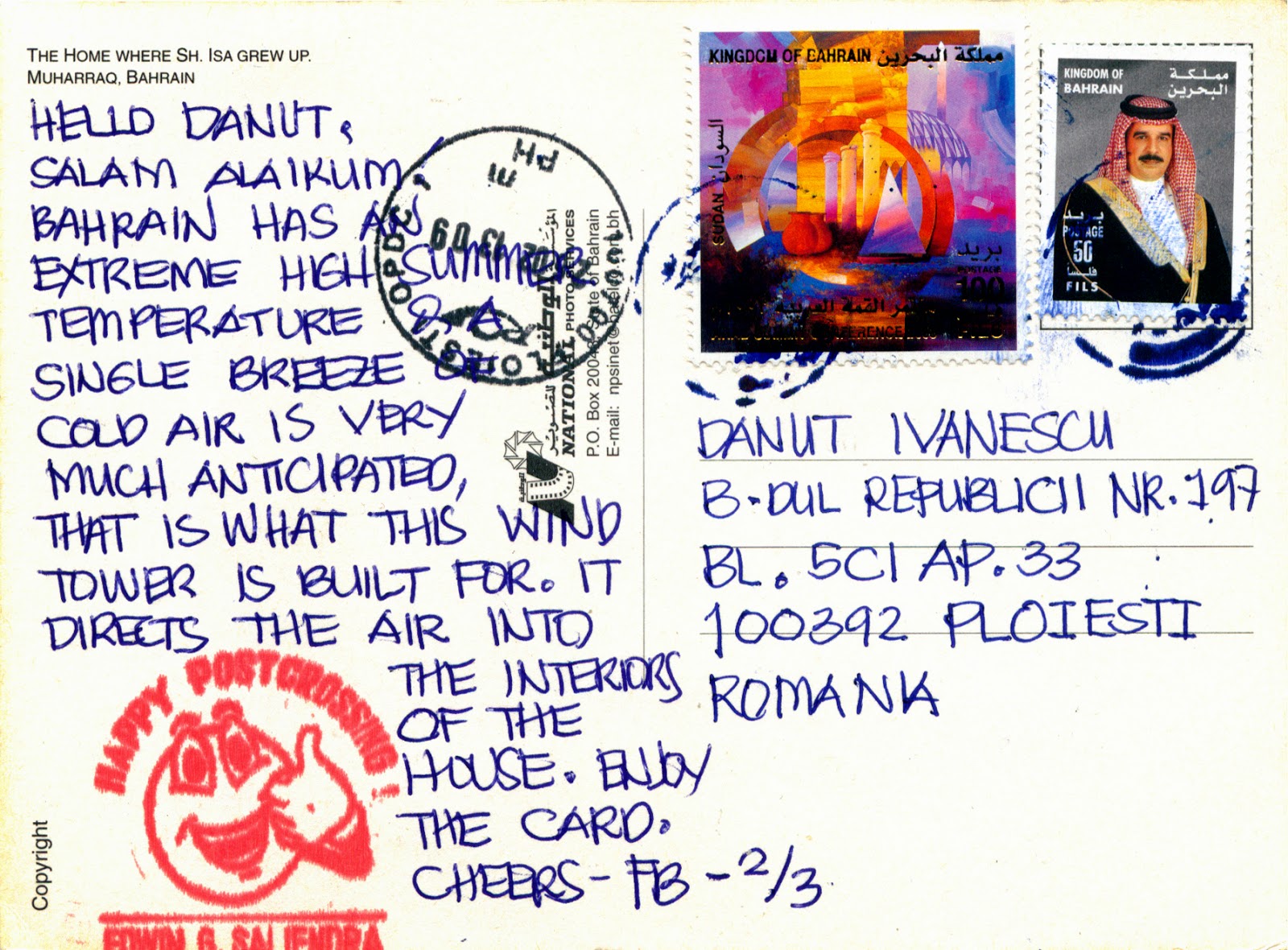
1006 BAHRAIN - Pearling, Testimony of an Island Economy (UNESCO WHS)

1006 Isa bin Ali House

Located on the island with the same name, Muharraq (literary "burned down" in Arabic) has long been a centre of religiosity, and even the capital of Bahrain until 1923, when it was replaced by Manama. Its origins goes back to the time of Dilmun (Telmun) 5,000 years ago, but the city became important during the era of Tylos, when Bahrain came under domination of the Seleucid Empire. By the 5th century AD, it had become a major centre of Nestorian Christianity.

February 14, 2014

1003 NETHERLANDS - Tulip fields & cheese girl


As wrote Wilma, this is, obviously, a touristic postcard, following three clichés about Netherlands: the tulips, the cheese and the Dutch bonnet. But it fully attains its purpose, because the image is catchy, and the bright colors and the pleasant smile, added for diversity, on the house, successfully contribute to the overall impression. From the first glance, you say, dreamy or enthusiastic, "I want to see this country." Am I wrong?

February 3, 2014

1002 SPAIN (Andalusia) - La Alcazaba in Málaga


Located on the Costa del Sol (Coast of the Sun) of the Mediterranean, at about 100 km east of the Strait of Gibraltar and about 130 km north of Africa, Málaga enjoys a subtropical-mediterranean climate and has a history of about three millennia. Founded by the Phoenicians, reached under the hegemony of Ancient Carthage, then was ruled by the Roman Republic and later the Roman Empire. After the fall of the empire, it was ruled first by the Visigoths and then by the Byzantine Empire, and in the 8th century was conquered by Moors, as most part of the Iberian Peninsula. In 1487 it again came under Christian rule in the Reconquista.

February 2, 2014

1001 RUSSIA - Lenin (1870-1924)


If Mahatma Gandhi was one of the most luminous personalities of the 20th century, Vladimir Ilyich Lenin (1870-1924) was one of the darkest. Born as Vladimir Ilyich Ulyanov to a middle-class family in Simbirsk (renamed Ulyanovsk after his death), Lenin was attracted by the revolutionary leftist politics following the execution of his brother in 1887. Expelled from Kazan State University for his radical attitude, he completed his law degree as an external student in 1891. In 1893 he moved to Saint Petersburg, where he began his career of professional revolutionary as cofounder of the League of Struggle for the Emancipation of the Working Class. Arrested and exiled to Siberia for three years, he married Nadezhda Krupskaya, and fled to Western Europe, where he emerged as a prominent figure in the international revolutionary movement and became the leader of the Bolshevik faction of the Russian Social Democratic Worker's Party.

January 30, 2014

0999 INDONESIA (Java) - Being the owner of a cock makes him proud


The truth is that the cock from the postcard is a really beautiful one. At first I believe that is a fighting cock, especially that cockfighting is a very old tradition in Balinese Hinduism, but then I realized that can't be, because it has big comb and wattle, and at the fighting cocks these are removed, because they would be a disadvantage during a match. Moreover, the man is Javanese. Anyway, the rooster is an important animal for many ethnic groups from Indonesia, of different religions. I don't know much about birds, so I can't say precisely what breed is, probably Bekisar or Kedu.

January 28, 2014

0998 GERMANY (Bavaria) - Freight locomotive 86 260 in 1968 at Plattling depot


The DRG Class 86 was a standard goods train tank locomotive with the Deutsche Reichsbahn-Gesellschaft (DRG) (German Imperial Railway Company), intended for duties on branch lines. They were of 2-8-2 wheel arrangement in the Whyte notation, or 1′D1′ h2 in the UIC classification, most often referred to as a Mikado, frequently shortened to Mike, but at times it was also referred as the McAdoo Mikado and, during WWII, the MacArthur. This wheel arrangement allows the locomotive's firebox to be placed behind instead of above the driving wheels, thereby allowing a larger firebox that could be both wide and deep. This supported a greater rate of combustion and thus a greater capacity for steam generation, allowing for more power at higher speeds.

January 27, 2014

0997 INDIA - Mahatma Gandhi (1869-1948)


In 1869, when was born Mohandas Karamchand Gandhi, had passed 11 years since the British Crown had taken over the direct rule of British Raj (comprising at that time almost all present-day India, Pakistan, Bangladesh, and Myanmar), and in 1948, when he was assassinated by a Hindu nationalist, just had taken place the partition of the British Indian Empire, which had resulted in the creation of the sovereign states of the Dominion of Pakistan (later split into the Islamic Republic of Pakistan and the People's Republic of Bangladesh) and the Union of India (later Republic of India). As though he came into the world just to destroy the British Raj and to bring independence to India. Known in the West as Mahatma (Great Soul in Sanskrit), name given by Rabindranath Tagore, and in India as Bapu (endearment for "father" in Gujarati), he was not only the man who led India to independence, but also the one who inspired movements for civil rights and freedom across the world, his rules about nonviolent civil disobedience  being followed by other important leaders and activists, as Martin Luther King Jr., Nelson Mandela, Aung San Suu Kyi, Cesar Chavez, or Desmond Tutu.

0996 FRANCE (New Aquitaine) - Bordeaux, Port of the Moon (UNESCO WHS)


Bordeaux is a port city on the Garonne River, in southwestern France, known mainly as the world's wine industry capital. At first a Celtic settlement, it came under Roman rule around 60 BC, being sacked by the Vandals, then by the Visigoths and Franks, who have taken it in possession. It started to play a regional role on the fringes of the Frankish Duchy of Vasconia, being meant to keep in check the Basques and defend the mouth of the Garonne from the Vikings. Between 12th and 15th centuries it regained importance following the marriage of Duchess Eleanor of Aquitaine with Count Henri Plantagenet, the future King Henry II of England. The city flourished, even being for a while the capital of an independent state, but in the end was annexed by France. In the 16th century it became the center of the distribution of sugar and slaves from the West Indies, along with the traditional wine. The 18th century was its golden age, many downtown buildings being built in this period. In 1870, at the beginning of the Franco-Prussian War, the French government relocated to Bordeaux. This happened again during the WWI and again very briefly during the WWII, when it was also a submarine base from Axis powers.

January 26, 2014

0989 MOROCCO - Two women, two colours, the same hayek


The Qur'an instructs both Muslim men and women to be modest. According to the Encyclopedia of Islam and Muslim World, this modesty concerns to gaze, gait, garments, and genitalia. The consequence is the hijab (that literally means in Arabic “screen" or "curtain”), which not only refers to the physical body covering, but also embodies a metaphysical dimension, where al-hijab refers to "the veil which separates man or the world from God." As clothing, hijab is a veil that covers the head and chest of the Muslim women beyond the age of puberty in the presence of adult males outside of their immediate family. He may have a broader sense, refering to any head, face, or body covering worn by Muslim women as a symbol of modesty, privacy and morality. A traditional Muslim garment is the abaya, a simple, loose over-garment, essentially a robe-like dress, traditionally black, a large square of fabric draped from the shoulders or head, or a long caftan. The abaya covers the whole body except the face, feet, and hands. It can be worn with the niqāb, a face veil covering all but the eyes.

January 25, 2014

0988 SPAIN (Andalusia) - The map of Andalusia


Even if Spain is a highly decentralized state, being composed, in terms of administrative, by 17 autonomous communities and 2 autonomous cities, is, in accordance with the constitution of 1978, a unitary state, not a federation. In other words, the Spanish nation is the common and indivisible homeland of all Spaniards, which is integrated by nationalities and regions to which the constitution recognizes and guarantees the right to self-government.

January 24, 2014

0029, 0987 INDIA (Tamil Nadu) - Great Living Chola Temples (UNESCO WHS)

0029 A gateway of  Brihadisvara Temple at Thanjavur

Posted on 06.11.2011, 24.01.2014
The Great Living Chola Temples, which includes the Brihadisvara Temple at Thanjavur, the Brihadisvara Temple at Gangaikondacholisvaram and the Airavatesvara Temple at Darasuram, were built by kings of the Chola Empire, which stretched over all of south India and the neighbouring islands. These complexes form a unique group, demonstrating a progressive development of high Chola architecture and art at its best and at the same time encapsulating a very distinctive period of Chola history and Tamil culture.

0987 A fresco in Brihadisvara Temple at Thanjavur
 

Brihadisvara temple, also known as Rajarajeswaram or Peruvudaiyar Kovil, is located in Thanjavur (formerly Tanjore), in the southern part of India. Dedicated to Lord Shiva and considered as one of the greatest glories of India, this temple reflects the power of its creator, Raja Raja Chola I (985-1014), the greatest of the Chola Monarchs, who built it between 1003 and 1010. The temple can be approached from the eastern side through two gateways (gopuras).