January 10, 2014

0959, 0960 SPAIN (Andalusia) - Cathedral, Alcázar and General Archive of the Indies in Seville (UNESCO WHS)

0959 Seville - Aerial view of the Cathedral
and The General Archive of the Indies

Situated in the fertile valley of the Guadalquivir, on the both banks of the river, Seville is approximately 2,200 years old, and the passage of the various civilisations has left it with a distinct personality. The mythological founder of the city is Hercules, but in reality was founded as the Roman city of Hispalis. Conquered by the Vandals and the Visigoths during the 5th and 6th centuries, in 712 it reached into the hands of the Moors, who have named it Ishbiliya.

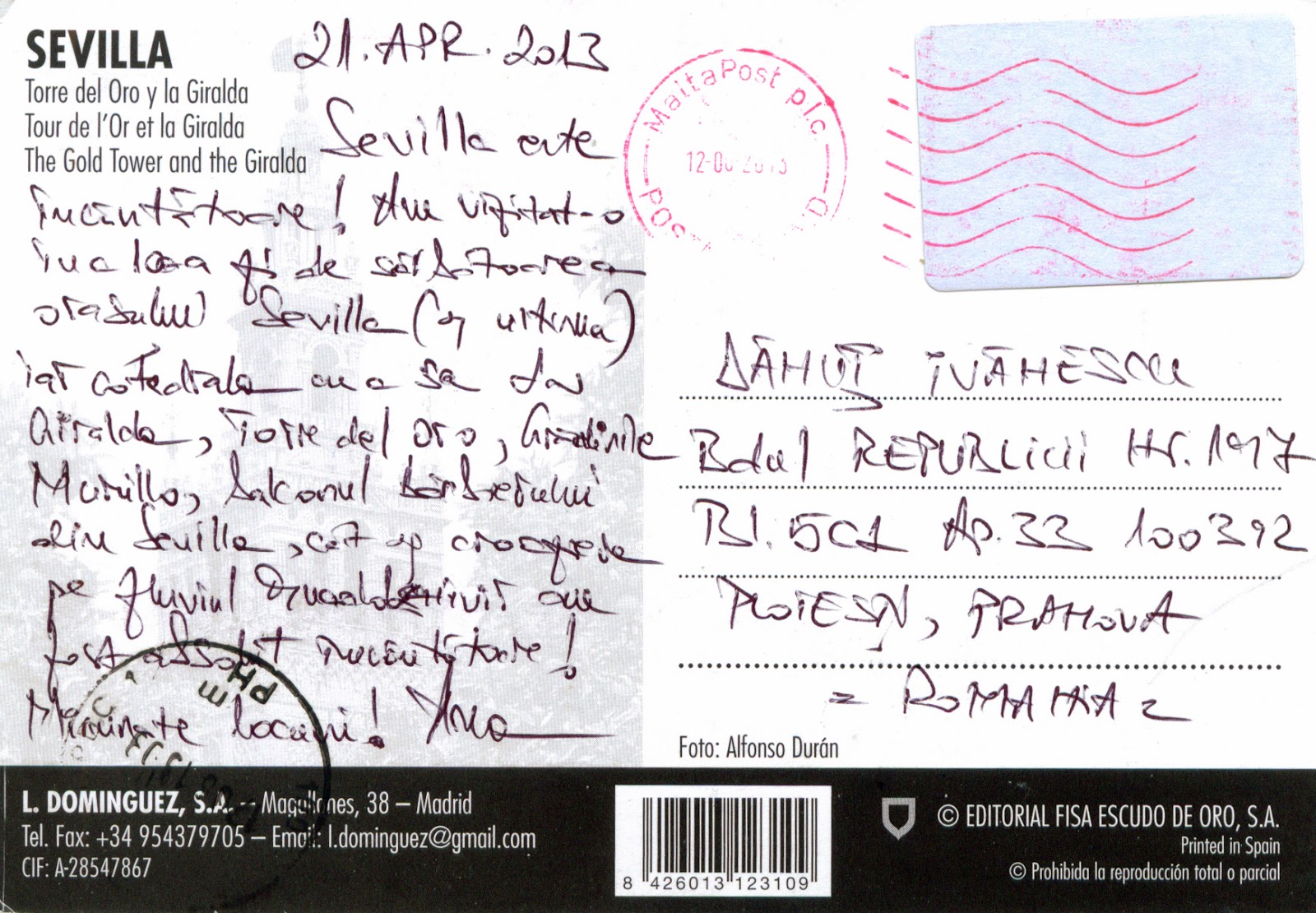
0960 Seville - The Gold Tower and the Giralda

After more than five centuries of Muslim rule, in 1248 Ferdinand III incorporated it into the Christian Kingdom of Castile. The discovery of the Americas transformed it in one of the economic centres of the Spanish Empire, as its port monopolised the trans-oceanic trade. Coinciding with the Baroque period, the 17th century represented the most brilliant flowering of the city's culture, but then began a gradual economic and demographic decline. Its Old Town, very well preserved, is the third largest in Europe. Cathedral, Alcázar and General Archive of the Indies form a remarkable monumental complex in the heart of the city.

0958 AUSTRALIA (Western Australia) - Drosera lowriei


As is well known, Australia is full of endemic species of plants and animals, because of the continent's long geographic isolation, tectonic stability, and the effects of an unusual pattern of climate change. One of these species of plants is Drosera lowriei (in the maxicard), formally described for the first time by N. G. Marchant in 1992, and named in honour of Allen Lowrie. Is a perennial tuberous species, endemic to Western Australia, and grows in a rosette about 3-4 cm in diameter (typical form) or 5-7 cm (giant form), in loam soils in wet zones near granite outcrops.

January 9, 2014

0956 BRAZIL (Mato Grosso) - The female ritual of Yamurikumã


When the Portuguese arrived in South America in the 16th century, Brazil was inhabited by an estimated 2.4 million Amerindians, of more than 2,000 nations and tribes. Massacres, slavery and diseases brought by the Europeans have drastically reduced their number, so that today of the 200 million Brazilians, only about 817.000 classified themselves as indigenous (0.4%). Among these are the Xingu peoples, who live near the river with the same name, a tributary of the Amazon River. The Upper Xingu was heavily populated prior to European contact, but in 1950s only about 500 Xingu peoples were alive. The Villas-Bôas brothers visited the area beginning in 1946 and pushed for creating the Xingu National Park, which was established in 1961. The number of Xingu living here in 32 settlements has risen again to today over 3000 inhabitants, half of them younger than 15 years.

January 8, 2014

0953 MALTA - Marsaxlokk and its Luzzu


Marsaxlokk is a picturesque fishing village located in the south-eastern part of Malta, with a population of 3,277 people. Its name comes from marsa (port) and xlokk, the local name for south east. The word is related to the name for the dry sirocco wind that blows from the Sahara. The Phoenicians landed here and set up trading posts during the 9th century BC, but evidence of habitation of the area are much older. The hill of Tas-Silġ, which overlook the northern arm of Marsaxlokk Bay, contains remains of megalithic temples, but also the remains of its use as a religious site, from the end of the 6th century BC to the 1st century AD, and also of the 4th century AD, when it was adapted to the new religion, Christianity.

0950-0952 UKRAINE (Volyn Oblast) - Lubart's Castle in Lutsk


According to the legend, Lutsk, located on the Styr River, now in northwestern Ukraine, was founded in the 7th century, but first documentary attestation dates from 1085. In 1321, the Lithuanians conquered the town, and had kept it for a century. Liubartas (Lubart), son of Gediminas the Great, erected the castle which will bear his name. The current castle was built mostly in the 1340s, being fortified to guard against artillery and gunfire during the reign of Vytautas the Great. The principal entrance, now bricked in, was from the west and adjoined a bridge over outer moat.


The castle repelled sieges by numerous potentates, including Casimir the Great (1349), Jogaila (1431), and Sigismund Kęstutaitis (1436). Its walls formerly enclosed St. John's Cathedral, the residence of the Grand Duke of Lithuania, and an episcopal palace. Of these buildings, only the Neoclassical palace of the bishops still stands. In castle took place in 1429 a conference of monarchs, having as subject the Tartar threat. In total more than 15,000 guests came to this congress, while the population of Lutsk itself was only about 5,000 residents.


In 1432 Volhynia became a fief of the Crown of the Kingdom of Poland and Lutsk became the seat of the governors, and later the Marshalls of Volhynia. In the same year, the city was granted Magdeburg rights, so it continued to prosper for a while, but during the Khmelnytskyi Uprising was looted and the population was slaughtered or fled. The town never fully recovered after that. Besides, in 1781 and 1845 was struck by devastating fires, and in 1795 was annexed by the Russia.

January 7, 2014

0949 CHINA (Sichuan) - A teahouse in Chengdu


A teahouse is an establishment which primarily serves tea and other light refreshments, and, even if its function varies widely depending on the culture, it often serves also as center of social interaction. In China, a teahouse is traditionally similar to the American cafe. People gather at teahouses to chat, socialize, and enjoy tea, and young people often meet at teahouses for dates. Tea culture in China differs from that of Europe, Britain or Japan in such things as preparation methods, tasting methods and the occasions for which it is consumed. Even now, in both casual and formal Chinese occasions, tea is consumed regularly.

0948 MAURITIUS - Wild and free


Not long ago I was the lucky winner of a lottery, and this wonderful postcard is the prize. A reason for joy, of course, to which is added the fact that it is a limited edition, that comes from Mauritius and, not least, that was made and sent by my pals Samuel and Vivi, whose works you can find here. It is however, also a cause for nostalgia, because I was (once upon a time) wild and free, like this bird, and now I became domestic and constraint, like a turkey. So it goes.

0920, 0932, 0947 UNITED STATES (Arizona) - Sonoran Desert


Posted on 27.12.2013, 31.12.2013, and 07.01.2014
The Sonoran Desert, one of the largest and hottest deserts in North America, covers large parts of the Southwestern United States and of Northwestern Mexico. It includes 60 mammal species, 350 bird species, 20 amphibian species, over 100 reptile species, 30 native fish species, over 1000 native bee species, and more than 2000 native plant species, among which are some endemic. Many plants not only survive, but thrive in the harsh conditions of the Sonoran Desert. It is the only place in the world where the famous saguaro (Carnegiea gigantea - in the first postcard) grows in the wild. Cholla (Cylindropuntia spp. - in the first postcard), beavertail (Opuntia basilaris - in the third postcard), hedgehog (Echinocereus spp.), fishhook (Ferocactus wislizeni), prickly pear (Opuntia spp.), nightblooming cereus (Peniocereus spp.), and organ pipe (Stenocereus thurberi - in the second postcard) are other taxa of cacti found here.


The saguaro (Carnegiea gigantea) is an arborescent cactus species which can grow to be over 20m tall. It is native to the Sonoran Desert, the Whipple Mountains and Imperial County areas of California. Native birds live inside holes in saguaros. Its blossom is the State Wildflower of Arizona. Cholla (Cylindropuntia spp).are native to northern Mexico and the Southwestern United States, and are known for their barbed spines that tenaciously attach to skin, fur, and clothing. The organ pipe cactus (Stenocereus thurberi) is found in rocky desert, and is susceptible to frost damage which kills the tips of the branches. It can reach a height of 7m. Beavertail cactus (Opuntia basilaris) is a medium-sized to small prickly pear cactus, growing to about 60 cm tall, found in southwest United States. The pink to rose colored flowers are most common; however, a rare variety of white and even yellow flowers also exist. It bloom from spring to early summer.


0946 POLAND (Silesia) - The main railway station of Bielsko-Biała


Formed in 1951 by the union of two former cities on opposite banks of the Biała River, Silesian Bielsko and Lesser Poland's Biała, Bielsko-Biała is a beautiful city, which has a vibrant modernistic presence being a student-city with its associated nightlife, as well as having numerous historical sights. One of this is the main railway station (Bielsko-Biała Główna), located in the city center.

January 6, 2014

0945 AUSTRALIA (Victoria) - Puffing Billy Railway


The Puffing Billy Railway is a narrow gauge railway (762 mm) located near Melbourne,  which runs through the southern foothills of the Dandenong Ranges to Gembrook. It was originally one of five narrow gauge lines of the Victorian Railways opened in 1900, closed in 1954, reopened in 1955, closed again in 1958, and reopened from 1962, in stages, now being kept in operation through the efforts of volunteers. Being close to Melbourne, the line is one of the most popular steam heritage railways in the world. Operations are centred on Belgrave, which houses the main offices of the railway.

0944 RUSSIA (Republic of Buryatia) - Ivolginsky datsan


In Buryatia, a republic located in the south-central region of Siberia, along the eastern shore of Lake Baikal, ethnic Russians make up two thirds of the population in nowadays, while the ethnic Buryats are 30%. Because many Slavs are Russian Orthodox, and most urban Buryats are either Buddhist or Orthodox, these two are the most widespread religions in the republic. The historical evidences give reason to believe that, from the 2nd century BCE, proto-Mongol peoples were familiar with Buddhism. Anyway, at the beginning of the 17th century, Tibetan Buddhism penetrated from Mongolia to reach the Buryat population of the area just east of Lake Baikal, and over a century it spread throughout the region. A second branch came directly from Tibet, from the Labrang Monastery in Amdo, so the Buddhism in Buryatia is the northernmost extension of Mahayana Buddhism in Central Asia, primarily the Gelug tradition from Tibet.

January 5, 2014

0942 PHILIPPINES (Northern Mindanao) - A Talaandig solemn ritual


Mindanao is the most culturally diverse island in the Philippines where people of different languages, tribes and races meet. The native Maguindanaon, Moro or Lumad groups have a culture that is different from the main culture of the Philippines. There are 17 ethnolinguistic groups Lumad (shortening for Katawhang Lumad, which in Cebuano literally means "indigenous peoples"), which at the beginning of the 20th century controlled an area covering now 17 of Mindanao’s 24 provinces, but by the 1980 census they constituted less than 6% of the population of Mindanao and Sulu. Katawhang Lumad are the un-Islamized and un-Christianized Austronesian peoples of Mindanao (about 20 general hilltribes). One of this tribes is the Talaandig, estimated to comprise about 100,000 people or more, who live in the province of Bukidnon, around the mountain of Kitanglad, their sacred "temple" and ancestral home. They have continued to preserve and promote its customs, beliefs and practices, despite the strong influx of modernization.

January 4, 2014

0941 POLAND (Greater Poland) - Raczyński Palace in Rogalin


Situated on the Warta river, at 19km south of Poznań, Rogalin is primarily known for its 18th-century baroque palace of the Raczyński family, and the adjacent Raczyński Art Gallery, housing a permanent exhibition of Polish and international paintings. The second reason for which the village Rogalin is known is a putatively 1000-year-old oak trees on the banks of the Warta. The last owner of the estate was Count Edward Bernard Raczyński, who in 1979-1986 was President of the Polish Republic in exile. His coffin is deposited in the Raczyński Mausoleum, under the historical chapel in Rogalin. In his testament, he bequeathed the palace in Rogalin and his library to the Polish people. Much of the surrounding area forms a protected area known as Rogalin Landscape Park.

0940 RUSSIA (Sakha / Yakutia Republic) - Lena Pillars Nature Park (UNESCO WHS)


Lena Pillars is the name given to a  spectacular rock formation located along the banks of the Lena River in far eastern Siberia, at less than a day's boat ride upriver (south) from the city of Yakutsk, the capital of the autonomous Sakha Republic. Formed in former Cambrian sea-basins, the pillars high of 150-300m looks like some buttresses isolated from each other by steep gullies developed by frost, directed along intervening joints. They were produced by the extreme continental climate, with an annual temperature range of almost 100 degrees Celsius (from -60 °C in winter to +40 °C in summer). Penetration of water from the surface has facilitated cryogenic processes (freeze-thaw action). The site also contains a wealth of Cambrian fossil, some of them unique. The Lena Pillars Nature Park was inscribed on the World Heritage List in 2012.

0939 GERMANY (Bavaria) - Steam locomotive for local service 98 307 in 1966 at Nuremberg main station depot


The Class PtL 2/2 locomotives of the Royal Bavarian State Railways were light and very compact superheated steam locomotives for operation on branch lines (Lokalbahnen). There were three types in total, of which two were transferred to the Deutsche Reichsbahn-Gesellschaft as Class 98.3 tank locomotives and even survived to join the Deutsche Bundesbahn (DB) fleet after WWII. All the variants have the B axle arrangement (0-4-0 in Whyte notation), the semi-automatic, gravity-feed firing that enabled one-man operation, platforms with guard rails, and a large driver's cab with 3 windows per side that surrounded the entire locomotive boiler as far as the smokebox (what brought it the nickname Glaskasten - Glass Box).

January 3, 2014

0938 UNITED STATES (Nevada) - Bellagio in Las Vegas


Bellagio is a luxury hotel and casino on the Las Vegas Strip, in Paradise (part of Las Vegas Township), built between 1996 and 1998 on the site of the demolished Dunes hotel and casino. Inspired by the Lake Como town of Bellagio in Italy, it is famed for its elegance, but also for the fountains with the same name, actually a large dancing water fountain synchronized to music. Inside Bellagio is Fiori di Como, a work by the glass sculptor Dale Chihuly, composed of over 2,000 hand-blown glass flowers, which covers 190 square metres of the lobby ceiling.

January 2, 2014

0936 CZECH REPUBLIC (South Bohemia) - Historic Centre of Český Krumlov (UNESCO WHS)


Named Český Krumlov (Bohemian Crumlaw) to differentiate it from Moravský Krumlov (Moravian Crumlaw), this small city situated on the banks of the Vltava river was built around a 13th century castle with Gothic, Renaissance and Baroque elements and, because is an outstanding example of a small central European medieval town whose architectural heritage has remained intact thanks to its peaceful evolution over more than five centuries, was designated a UNESCO World Heritage Site in 1992.

0935 TAIWAN - Dome of Light in Kaohsiung City


Situated in Kaohsiung City, at the metro transfer station for the Red Line and Orange Line (Formosa Boulevard Station), the Dome of Light was created by renowned Italian artist Narcissus Quagliata, and is the world's largest public art installation made from individual pieces of colored glass. It has 30m in diameter and covers an area of 660 square metres, being made up of 4,500 glass panels. The dome tells the story of human life in four chronologically arranged themes: Water: The Womb of Life; Earth: Prosperity and Growth; Light: The Creative Spirit; and Fire: Destruction and Rebirth, with an overall message of love and tolerance.

0934 UNITED KINGDOM (Wales) - The Cenarth Falls


Located in the village with the same name, the Cenarth Falls is a cascade notable as the first significant barrier on the River Teifi, that salmon and migratory seatrout encounter on their return to their home river as they make their way upstream to spawn. The less well-known Henllan Falls a few miles upstream provides similar opportunities to watch fish migration. In late summer and throughout autumn Salmon can be watched "jumping" the waterfalls and of course anglers can be observed trying their luck at catching a fish from April onwards.

January 1, 2014

0933 NEW YEAR (Russia) - Russian dancer


This wonderful work of Lia Selina, a digital artist and illustrator from Russia, isn't really a New Year postcard, but could be one. It depict a girl dressed in a traditional russian costume, with a sarafan long to the ankles, a shirt with large sleeves, tight to wrists, and a richly decorated kokoshnik.