November 24, 2019

1180, 1181, 3265 ROMANIA (Tulcea) - Danube Delta (UNESCO WHS)

3265 Danube Delta - Flying birds

Posted on 13.08.2014, 24.11.2019
The Danube Delta is the second largest river delta in Europe, after Volga Delta, and is the best preserved on the continent. The greater part lies in Romania (Tulcea county), while its northern part, on the left bank of the Chilia arm, is situated in Ukraine (Odessa Oblast). The modern Danube Delta began to form after 4000 BCE in a bay of the Black Sea, when the sea rose to its present level. A sandy barrier blocked the Danube bay where the river initially built its delta. Probably 40 percent of the Delta was built in the last 1000 years. The reserve is vast, with numerous freshwater lakes interconnected by narrow channels featuring huge expanses of aquatic vegetation. 

1181 Birds of Danube Delta
 

This is the largest continuous marshland on Europe, which includes the greatest stretch of reedbeds in the world, which form floating or fixed islands of decaying vegetation. The Razelm-Sinoe complex to the south comprises several large brackish lagoons separated from the sea by a sandbar. The higher ground supports stands of willow, popular, alder and oak. There are also sandy areas covered with feather grass and other steppe species. Forest elements are best observed in Letea Forest (in the postcard 1180) where a series of bands occur along dunes up to 250 m long and 10 m wide.

1180 Danube Delta - Letea Forest

Situated on major migratory routes, and providing adequate conditions for nesting and hatching, the Danube Delta is a magnet for birds from six major eco-regions of the world, including the Mongolian, Arctic and Siberian. There are over 320 species of birds found in the delta during summer, of which 166 are hatching species and 159 are migratory. Over one million individuals (swans, wild ducks, bald coots, etc.) winter here. An interesting ethologic aspect appearing enhanced by the conditions of the Danube Delta (especially by the floods) is represented by egg laying in common nests. Thus, as a consequence of the general lack of egg-laying places, especially at flood time when a great part of the aquatic-species nests are flooded, the birds this way affected go on laying eggs in alien nests either belonging to the same species or to species of the same families.

1172, 1365, 3264 SWEDEN - Swedish Royal Family

1172 Swedish Royal Family on Sweden's National Day.
From left to right: Prince Daniel, Crown Princess Victoria,
Prince Carl Philip, Queen Silvia of Sweden, King Carl XVI Gustaf,
Princess Madeleine, Christopher Paul O'Neill.

Posted on 31.07.2014, 20.12.2014, 24.11.2019
The current royal house of Sweden is the House of Bernadotte, which has reigned since 1818, and between 1818 and 1905 was also the royal house of Norway. Its founder, Charles XIV John of Sweden (r. 1818-1844), was adopted by Charles XIII of Sweden (r. 1809-818), the last member of the House of Holstein-Gottorp. In the postcard 1172 are several members of the Swedish royal family. In the middle are King Carl XVI Gustaf (full name: Carl Gustaf Folke Hubertus, born 30 April 1946), and his spouse, Queen Silvia of Sweden (née Silvia Renate Sommerlath; born 23 December 1943).

3264 Swedish Royal Family after the Nobel awards ceremony, 2015.
From left to right: Christopher Paul O'Neill, Princess Madeleine, Prince Daniel,
Queen Silvia of Sweden, King Carl XVI Gustaf, Crown Princess Victoria,
Prince Carl Philip, Princess Sofia.

On 15 September 1973, Carl Gustaf succeeded his grandfather Gustaf VI Adolf. He is the only son of Prince Gustaf Adolf, Duke of Västerbotten, and Princess Sibylla of Saxe-Coburg and Gotha. In 2011, Silvia (the daughter of Walther Sommerlath and his Brazilian wife Alice, née Soares de Toledo) became the longest serving queen consort of Sweden, a record previously held by Sophia of Nassau. In the left of the royal couple is Prince Carl Philip, Duke of Värmland (Carl Philip Edmund Bertil; born 13 May 1979), the only son of the King Carl XVI Gustaf and Queen Silvia.

1365 King Carl XVI Gustaf and Queen Silvia in a carriage.


On 13 June 2015 Carl Philip and former glamour model Sofia Hellqvist married in Stockholm's Royal Palace chapel. On 19 April 2016, Princess Sofia gave birth to a son, Prince Alexander, Duke of Södermanland (Alexander Erik Hubertus Bertil). Their second child, also a son, was born on 31 August 2017, titled Prince Gabriel, Duke of Dalarna (Gabriel Carl Walther).

November 23, 2019

0281, 3263 BULGARIA (Shumen) - Madara Rider (UNESCO WHS)

0281 - Madara Rider (1)

Posted on 18.07.2012, 23.11.2019
Because of the richness of archaeological monuments discovered in this zone,  Madara, a village in northeastern Bulgaria, which lies at the western foot of the Madara plateau, is called "the Bulgarian Troy". The Madara National Historical and Archaeological Reserve, located near to the village, includes Neolithic and Eneolithic findings, a Thracian settlement, Ancient Roman villa and fortress from the 2nd-5th century, medieval Bulgarian palace, pagan sanctuaries, Christian churches and monasteries, fortresses from the First Bulgarian Empire, and a cave monastery from the 12th–14th century. Most importantly, Madara is the location of the famous Madara Rider, an early medieval rock relief carved by the Bulgars, which is on the UNESCO World Heritage List since 1979.

3263 - Madara Rider (2)

Madara Rider, the only monumental stone bas-relief in Europe, dated to about 710 AD, is hewn into sheer cliffs at a height of 23m, and presents a horseman who has speared a lion, with an eagle flying in front and a dog running after him, the carving being surrounded by three inscriptions in Greek, which are a short chronicle of the Bulgarian-Byzantine relations in those times. The image is obvious a scene of triumph, incarnating the grandeur of the Bulgars ruler and the power of the Bulgar state. If the bas-relief was carved during the rule of the Bulgar Khan Tervel (r. 700–721), and is probably a portrayal of the khan himself, a part of the inscriptions (of which content can be found here) were made later, describing events  that occurred during the reigns of Krum (803–814), Omurtag (r. 814–831), and Malamir (r. 831–836).

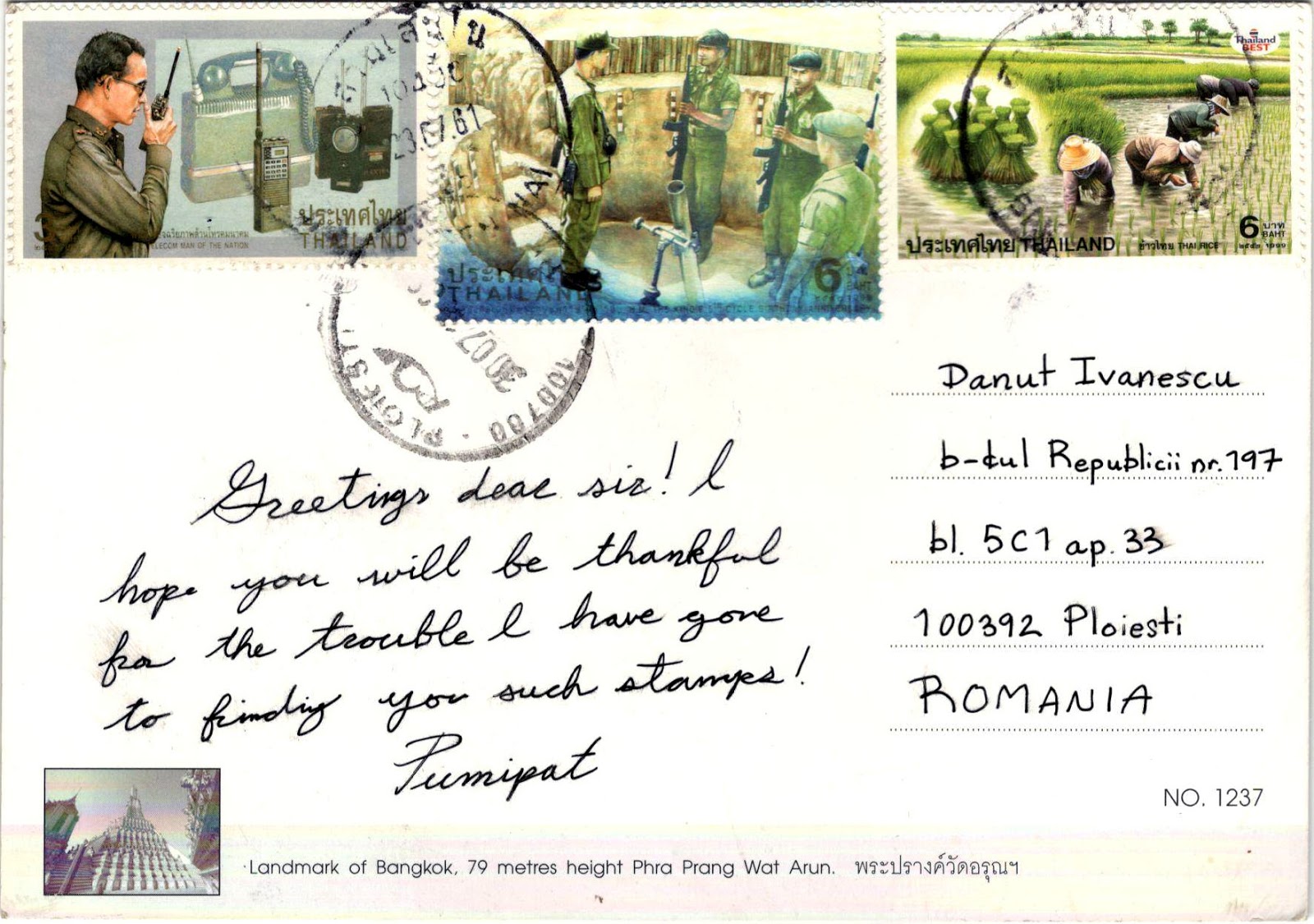
1824, 3181, 3262 THAILAND (Bangkok) - Wat Arun in Bangkok

1824 Wat Arun (1)

Posted on 15.08.2015, 28.10.2017, 23.11.2019
Wat Arun (Wat Arun Ratchawararam Ratchawaramahawihan, "Temple of Dawn") is a Buddhist temple in  Bangkok Yai district of Bangkok, on the Thonburi west bank of the Chao Phraya River. The temple derives its name from the Hindu god Aruna, often personified as the radiations of the rising sun. Although the temple had existed since at least the 17th century, its distinctive prang (spires) were built in the early 19th century during the reign of King Rama II.

3181 Wat Arun (2)

A Buddhist temple (Wat Makok) had existed on this site since the time of the Ayutthaya Kingdom, which was renamed Wat Chaeng by King Taksin when he established his new capital of Thonburi, near the temple. It enshrined the Emerald Buddha before it was transferred to Wat Phra Kaew in 1785. The temple was located in grounds of the royal palace during Taksin's reign, then it was abandoned until Rama II, who restored it and extended the pagoda to 70m.

3262 Wat Arun (2)

The main feature of Wat Arun is its central prang (Khmer-style tower) which is encrusted with colourful porcelain. The corners are surrounded by four smaller satellite prang, decorated by seashells and bits of porcelain which had previously been used as ballast by boats coming from China. Construction of the five prang was started by King Rama II during 1809-1824 and completed by King Rama III (1824-1851). The central prang is topped with a seven-pronged trident, referred to by many sources as the "Trident of Shiva". Around the base of the prang are various figures of ancient Chinese soldiers and animals. Over the second terrace are four statues of the Hindu god Indra riding on Erawan.

February 5, 2018

3261 ROMANIA (Bucharest) - Postcrossing Meetup, Bucharest, 20 January 2018

3261 The second postcard of the series
"100 years since the Great Union of Romania" (2/12)
- The interior of the Romanian Athenaeum

The second meeting of the Romanian postcrossers in the year of the Centenary of the Great Union (the 34th in total) took place on January 20, 2018 at the premises of the Philatelic Association of Bucharest. Since around this date the Romanians had other two reason to celebrate, these were also mentioned on the postcard. The first one was the National Culture Day, celebrated on January 15, the day in which in 1850 was born Mihai Eminescu, the Romanian national poet.

February 4, 2018

3259 FRANCE (Auvergne-Rhône-Alpes) - Peasants of Ardeche in 1970's

3259 Joseph, Noemie and Celestin, paysans d'Ardeche in 1970's

Ardèche is a département in south-central France,  named after the River Ardèche. Picturesque, lush and wild, this département is a tapestry of ancient grey rock, verdant hills and thick forests. Heavily loaded with history and tradition, the sparsely populated Ardèche region is the perfect place to lose yourself in the simplest pleasures that rural France can offer, namely hearty regional fare and untamed beauty. The Ardèche is known in France as "chestnut country", and, for many locals, this anonymous wintertime ingredient holds iconic status. This explains its prominence in so many dishes and the region’s position as France’s leading producer.

February 3, 2018

3258 POLAND (Lesser Poland) - International Postcrossing Meetup, Kraków, January 8, 2018


The first Polish Postcrossing meetup in 2018 occured on 8 January in Kraków, in Kazimierz district, somewhere near Q Hotel Plus, starting 4:30 afternoon. The special postcard issued with this occasion depicts Saint Mary's Basilica (Church of Our Lady Assumed into Heaven) seen from Sukiennice (Kraków Cloth Hall), across the Main Market Square in Kraków. This square is one of the four core areas of Historic Centre of Kraków, an UNESCO World Heritage Site about which I wrote here.

3257 GERMANY (Rhineland-Palatinate) - Landau

3257 Landau - The Market Hall and
the statue of Prince Luitpold in Town Hall Square

Landau, or Landau in der Pfalz, is an autonomous (kreisfrei) town surrounded by the Südliche Weinstraße (Southern Wine Route) district. It is a long-standing cultural centre, and a market and shopping town, surrounded by vineyards and wine-growing villages of the Palatinate wine region. Landau was first mentioned as a settlement in 1106, and was granted a charter in 1274 by King Rudolf I of Germany, who declared the town a Free Imperial Town in 1291.

3256 MYANMAR (Yangon Region) - Karaweik Hall


The Karaweik Hall, also known as Karaweik Palace is one of Yangon's many landmarks. From a distance, it looks like a huge golden barge floating on Kandawgyi Lake, glittering in the sun. The word karaweik comes from Pali karavika, which is a mythical bird with a melodious cry. The barge was designed by Burmese architect U Ngwe Hlaing, who based it on the Pyigyimon royal barge. Construction began in June 1972 and it was finished in October 1974.

February 2, 2018

3255 FRANCE (Occitania) - The people of Lozère


Located in the region of Occitanie in southern France near the Massif Central, Lozère is the least populated French department, due to its mountainous relief, and to poor soil quality. There is barely any agricultural farming in Lozère, the main activities being cattle farming and tourism. It is one of the few region where the langue d'oc is spoken fluently because it remained an agricultural department, and that people are attached to their roots. And if the Lozériens speak French, it is strongly mixed with Occitan, what some call the patois.

February 1, 2018

2401, 3243, 3254 UNITED STATES - John F. Kennedy (1917-1963) and Jacqueline Kennedy (1929-1994)

3243 JFK at Cape Cod.

Posted on 24.03.2016, 11.01.2018, 01.02.2018
John Fitzgerald "Jack" Kennedy, commonly known as JFK, was the 35th President of the United States, and certainly one of the most important and loved. The Cuban Missile Crisis, The Bay of Pigs Invasion, the Nuclear Test Ban Treaty, the establishment of the Peace Corps, developments in the Space Race, the building of the Berlin Wall, the Civil Rights Movement, and abolition of the federal death penalty in the District of Columbia all took place during his presidency. He also avoided any significant increase in the American presence in Vietnam.

2401 JFK and Jackie... summer of '60
Hyannisport, Massachusetts


JFK was born in Brookline (Massachusetts) on May 29, 1917, as one of the nine children of businessman/politician Joseph Patrick "Joe" Kennedy, Sr. and philanthropist/socialite Rose Elizabeth Fitzgerald-Kennedy. Both the Fitzgeralds and the Kennedys were wealthy and prominent Irish Catholic Boston families. John F. Kennedy, nicknamed "Jack," was the second oldest of a group of nine extraordinary siblings, who remained close-knit and supportive of each other throughout their entire lives.
 
3254 Jacqueline and John F. Kennedy, New York City, 1960

At school, although he was obviously brilliant - evidenced by the extraordinary thoughtfulness and nuance of his work on the rare occasions when he applied himself - Kennedy remained at best a mediocre student, preferring sports, girls and practical jokes to coursework. He was also chronically ill during his childhood and adolescence; he suffered from severe colds, the flu, scarlet fever and even more severe, undiagnosed diseases that forced him to miss months of school at a time and occasionally brought him to the brink of death.

0549, 2030, 3253 IRELAND (Leinster) - Trinity College - part of The Historic City of Dublin (UNESCO WHS - Tentative List)

2030 Dublin - Trinity College

Posted on 11.03.2013, 13.11.2015, 01.02.2018
Probable that Dublin no longer looks as it was presented in Dubliners by Joyce, but certainly that Trinity College, the sole constituent college of the University of Dublin, hasn't changed much since Beckett studied there, from 1923 to 1927. Founded in 1592 as the "mother" of a new university, and modelled after the collegiate universities of Oxford and of Cambridge, it's one of the seven ancient universities of the British Isles, and was originally intended to consolidate the rule of the Tudor monarchy in Ireland, being seen as the university of the Protestant Ascendancy for much of its history.

0549 Dublin - The Long Room from
Trinity College Library (1)

Although Roman Catholics and Dissenters had been permitted to enter in college since 1793, the professorships, the fellowships and the scholarships were reserved for Protestants until 1873, and the Catholic Church forbade its adherents from attending, without permission of their bishop, until 1970. Its library is the largest research library in Ireland, and a legal deposit library for the UK and Ireland, so it receives a copy of every book published in Great Britain and Ireland, which means 100,000 new items every year. It contains circa five million books, including significant collections of manuscripts, maps, and printed music.

3253 Dublin - The Long Room from Trinity College Library (2)

The Book of Kells, created by Celtic monks ca. 800, is by far its most famous book and is located in the Old Library. As is writes on the postcard, "The main chamber of the Old Library, the Long Room, is nearly 65m in length, and houses around 200,000 of the Library's oldest books. In 1860 the roof was raised to allow the construction of the present barrel-vaulted ceiling and gallery bookcases. Marble busts are placed down either side of the room which also contains the oldest surviving harp in Ireland." It's about the Brian Boru harp, one of the three surviving medieval Gaelic harps, and a national symbol of Ireland (used also on the Irish Euro coins), received by the college in the 18th century.

January 28, 2018

3252 POLAND (Podlaskie) - The Augustów Canal (UNESCO WHS - Tentative List)


The Augustów Canal (Kanał Augustowski) is a cross-border canal built in the 19th century in the present-day Podlaskie Voivodeship of northeastern Poland and the Grodno Region of north-western Belarus (then the Augustów Voivodeship of the Kingdom of Poland). From the time it was first built, the canal was described by experts as a technological marvel, with numerous sluices contributing to its aesthetic appeal. The completed part of the canal remained an inland waterway of local significance until rendered obsolete by the regional railway network.

3251 SPAIN (Andalusia) - Salobreña


Located in Granada, on the Costa Tropical, Salobreña claims a history stretching back 6,000 years. The Old Town which sits atop a rocky prominence (Gran Peñón) and is a cluster of whitewashed houses and quirky steep narrow streets leading up to a 10th-century Moorish castle. Another interesting building is the parish church of Nuestra Señora del Rosario, built in the 16th century on the site of an old mosque. The different districts of the town, like La Loma, La Fuente, El Brocal and el Albaycín, have medieval corners with openings for doors, arches and windows.

January 23, 2018

3250 FRANCE (Brittany) - A traditional breton farm


The rural architecture of France has a rich variety, because the farms are the expression of the coexistence of several agrarian civilisation, of the variety of natural environments and of types of farming. In Brittany, specific are the long, low, compact houses, with transverse elements. The house and the farm buildings such as stables and sheds, are built in a row under the same roof in the case of small farms, and under roofs of different  of heights in the case of large farms; the house thus consists of juxtaposed units.