![]() |
| 0970 Trinity Suburb in Minsk City |
January 16, 2014
0970 BELARUS (Minsk City) - Trinity Suburb
Locaţia:
Trinity Hill, Minsk, Belarus
January 15, 2014
0969 CZECH REPUBLIC (Central Bohemia) - Kutná Hora: Historical Town Centre with the Church of St Barbara and the Cathedral of Our Lady at Sedlec (UNESCO WHS)
Locaţia:
Kutná Hora, Republica Cehă
0968 UNITED STATES (Kentucky) - Fort Knox
January 14, 2014
0967 BELARUS (Mogilev) - Saint Nicholas Monastery
![]() |
| 0967 Saint Nicholas Monastery in Mogilev |
Locaţia:
Mogilev, Belarus
0966 RUSSIA (Krasnoyarsk Krai) - Putorana Plateau (UNESCO WHS)
Locaţia:
Norilsk, Ținutul Krasnoiarsk, Rusia
January 12, 2014
0965 CHINA (Shaanxi) - Inside the Yellow Earth
Etichete:
AS - ASIA,
AS-China,
CHINA,
CHINA (Shaanxi)
Locaţia:
Shaanxi, China
January 11, 2014
0962 VIETNAM (Mekong Delta) - An Thoi fishing village in Phú Quốc island
Located in the Gulf of Thailand, just 12km south of the (now) Cambodian coast, the mountainous and densely forested island Phú Quốc (known as Koh Trol in Khmer) now belongs to Vietnam, but was and is a bone of contention between the governments of Cambodia and Vietnam. In the early 17th century, it was a desolate area, where Vietnamese and Chinese immigrants earned their living from sea cucumbers. In 1869, the French occupied it to set up rubber and coconut plantations. Anyway, in the late 19th and early 20th century less than 1,000 people resided on island, mostly distributed among small fishing communities, and even at the end of WWII the population was still less than 5,000. In 1949, after China fell under the control of the Communist Party, more then 33,000 Republic of China Army soldiers came in Phú Quốc, but they went to Taiwan in 1953. During the Vietnam War, the island housed South Vietnam's largest prisoner camp (40,000 in 1973).
Etichete:
AS - ASIA,
AS-Vietnam,
VIETNAM,
Watercrafts
0961 GERMANY (Hesse) - Express locomotive 01 523 in 1965 in Bebra station
The DR Class 01.5 was the designation given by the Deutsche Reichsbahn in East Germany to express train locomotives that were reconstructed from DRG Class 01, the first standardised (Einheitsdampflokomotive) steam express passenger locomotives built by the unified German railway system. They were of 4-6-2 wheel arrangement in the Whyte notation, or 2′C1′ h2 in the UIC classification, almost globally known as Pacific type. The firms of AEG and Borsig, together with Henschel, Hohenzollern, Krupp and BMAG previously Schwartzkopff, delivered a total of 231 of these locomotives between 1926 and 1938, the one from the postcard, No. 01 191, being built in 1937.
Etichete:
GERMANY,
GERMANY (Hesse),
stamps (complete series),
trains
Locaţia:
Bebra, Germany
January 10, 2014
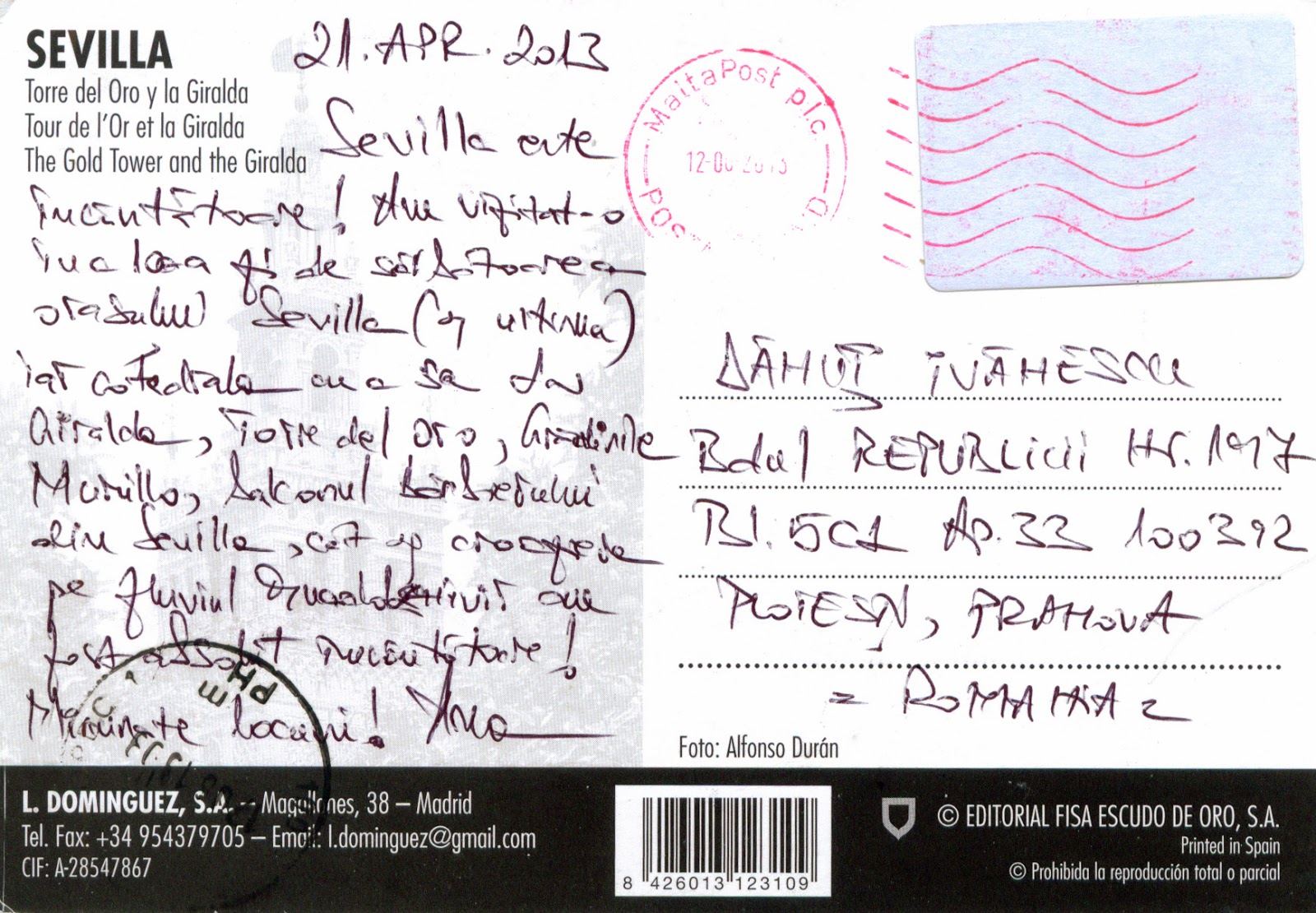
0959, 0960 SPAIN (Andalusia) - Cathedral, Alcázar and General Archive of the Indies in Seville (UNESCO WHS)
![]() |
| 0959 Seville - Aerial view of the Cathedral and The General Archive of the Indies |
![]() |
| 0960 Seville - The Gold Tower and the Giralda |
After more than five centuries of Muslim rule, in 1248 Ferdinand III incorporated it into the Christian Kingdom of Castile. The discovery of the Americas transformed it in one of the economic centres of the Spanish Empire, as its port monopolised the trans-oceanic trade. Coinciding with the Baroque period, the 17th century represented the most brilliant flowering of
the city's culture, but then began a gradual economic and demographic
decline. Its Old Town, very well preserved, is the third largest in
Europe. Cathedral, Alcázar and General Archive of the Indies form a remarkable monumental complex in the heart of the city.
Etichete:
Aerial view,
Places of worship,
Received from Ana,
SPAIN,
SPAIN (Andalusia),
UNESCO World Heritage Sites
Locaţia:
Seville, Sevilla, Spain
0958 AUSTRALIA (Western Australia) - Drosera lowriei
Locaţia:
Western Australia, Australia
January 9, 2014
0956 BRAZIL (Mato Grosso) - The female ritual of Yamurikumã
Etichete:
AM - AMERICAS,
AM-Brazil,
BRAZIL
Locaţia:
Feliz Natal, Mato Grosso, Brazil
January 8, 2014
0953 MALTA - Marsaxlokk and its Luzzu
Etichete:
MALTA,
Received from Ana,
Watercrafts
Locaţia:
Marsaxlokk, Malta
0950-0952 UKRAINE (Volyn Oblast) - Lubart's Castle in Lutsk
The castle repelled sieges by numerous potentates, including Casimir the Great (1349), Jogaila (1431), and Sigismund Kęstutaitis (1436). Its walls formerly enclosed St. John's Cathedral, the residence of the Grand Duke of Lithuania, and an episcopal palace. Of these buildings, only the Neoclassical palace of the bishops still stands. In castle took place in 1429 a conference of monarchs, having as subject the Tartar threat. In total more than 15,000 guests came to this congress, while the population of Lutsk itself was only about 5,000 residents.
In 1432 Volhynia became a fief of the Crown of the Kingdom of Poland and Lutsk became the seat of the governors, and later the Marshalls of Volhynia. In the same year, the city was granted Magdeburg rights, so it continued to prosper for a while, but during the Khmelnytskyi Uprising
was looted and the population was slaughtered or fled. The town never
fully recovered after that. Besides, in 1781 and 1845 was struck by
devastating fires, and in 1795 was annexed by the Russia.
Locaţia:
Lutsk, Volyns'ka oblast, Ukraine
January 7, 2014
0949 CHINA (Sichuan) - A teahouse in Chengdu
A teahouse is an establishment which primarily serves tea and other light refreshments, and, even if its function varies widely depending on the culture, it often serves also as center of social interaction. In China, a teahouse is traditionally similar to the American cafe. People gather at teahouses to chat, socialize, and enjoy tea, and young people often meet at teahouses for dates. Tea culture in China differs from that of Europe, Britain or Japan in such things as preparation methods, tasting methods and the occasions for which it is consumed. Even now, in both casual and formal Chinese occasions, tea is consumed regularly.
Etichete:
AS - ASIA,
AS-China,
CHINA,
CHINA (Sichuan)
Locaţia:
Chengdu, Sichuan, China
0948 MAURITIUS - Wild and free
Locaţia:
Rodrigues, Mauritius
0920, 0932, 0947 UNITED STATES (Arizona) - Sonoran Desert
Posted on 27.12.2013, 31.12.2013, and 07.01.2014
The Sonoran Desert, one of the largest and hottest deserts in North America, covers large parts of the Southwestern United States and of Northwestern Mexico. It includes 60 mammal species, 350 bird species, 20 amphibian species, over 100 reptile species, 30 native fish species, over 1000 native bee species, and more than 2000 native plant species, among which are some endemic. Many plants not only survive, but thrive in the harsh conditions of the Sonoran Desert. It is the only place in the world where the famous saguaro (Carnegiea gigantea - in the first postcard) grows in the wild. Cholla (Cylindropuntia spp. - in the first postcard), beavertail (Opuntia basilaris - in the third postcard), hedgehog (Echinocereus spp.), fishhook (Ferocactus wislizeni), prickly pear (Opuntia spp.), nightblooming cereus (Peniocereus spp.), and organ pipe (Stenocereus thurberi - in the second postcard) are other taxa of cacti found here.
The saguaro (Carnegiea gigantea) is an arborescent cactus species which can grow to be over 20m tall. It is native to the Sonoran Desert, the Whipple Mountains and Imperial County areas of California. Native birds live inside holes in saguaros. Its blossom is the State Wildflower of Arizona. Cholla (Cylindropuntia spp).are native to northern Mexico and the Southwestern United States, and are known for their barbed spines that tenaciously attach to skin, fur, and clothing. The organ pipe cactus (Stenocereus thurberi) is found in rocky desert, and is susceptible to frost damage which kills the tips of the branches. It can reach a height of 7m. Beavertail cactus (Opuntia basilaris) is a medium-sized to small prickly pear cactus, growing to about 60 cm tall, found in southwest United States. The pink to rose colored flowers are most common; however, a rare variety of white and even yellow flowers also exist. It bloom from spring to early summer.
0946 POLAND (Silesia) - The main railway station of Bielsko-Biała
Formed in 1951 by the union of two former cities on opposite banks of the Biała River, Silesian Bielsko and Lesser Poland's Biała, Bielsko-Biała is a beautiful city, which has a vibrant modernistic presence being a student-city with its associated nightlife, as well as having numerous historical sights. One of this is the main railway station (Bielsko-Biała Główna), located in the city center.
Etichete:
POLAND,
POLAND (Silesia),
Railway Stations
January 6, 2014
0945 AUSTRALIA (Victoria) - Puffing Billy Railway
Locaţia:
Belgrave VIC 3160, Australia
0944 RUSSIA (Republic of Buryatia) - Ivolginsky datsan
Etichete:
AS - ASIA,
AS-Russia,
Places of worship,
RUSSIA,
RUSSIA (Republic of Buryatia)
Locaţia:
Ivolginskiy rayon, Buryatia, Russia
January 5, 2014
0942 PHILIPPINES (Northern Mindanao) - A Talaandig solemn ritual
Mindanao is the most culturally diverse island in the Philippines where people of different languages, tribes and races meet. The native Maguindanaon, Moro or Lumad groups have a culture that is different from the main culture of the Philippines. There are 17 ethnolinguistic groups Lumad (shortening for Katawhang Lumad, which in Cebuano literally means "indigenous peoples"), which at the beginning of the 20th century controlled an area covering now 17 of Mindanao’s 24 provinces, but by the 1980 census they constituted less than 6% of the population of Mindanao and Sulu. Katawhang Lumad are the un-Islamized and un-Christianized Austronesian peoples of Mindanao (about 20 general hilltribes). One of this tribes is the Talaandig, estimated to comprise about 100,000 people or more, who live in the province of Bukidnon, around the mountain of Kitanglad, their sacred "temple" and ancestral home. They have continued to preserve and promote its customs, beliefs and practices, despite the strong influx of modernization.
Etichete:
AS - ASIA,
AS-Philippines,
PHILIPPINES
Locaţia:
Mindanao, Philippines
Subscribe to:
Posts (Atom)