Showing posts with label DENMARK. Show all posts

May 25, 2017

3065 DENMARK (Nordjylland) - Jens Bang's House in Aalborg


Jens Bang's House, on Østerågade in Nytorv square, near the old town hall of Aalborg, is one of Denmark's best examples of 17th-century domestic architecture. Built in 1624 by the Aalborg merchant Jens Bang in the Dutch Renaissance style, the four-story sandstone building is noted for its rising gables and sculpted auricular window decorations. For over 300 years, it has housed the city's oldest pharmacy. The Svaneapotek (Swan Pharmacy) collection is now housed in one of the upper rooms, as a small pharmacy museum known as Apotekersamlingen.

August 1, 2016

2673 DENMARK (Faroe Islands) - Traditional food

2673 Faroese specialities. From ther left: hares, whale meat strips,
guillemots, intestines, cod's heads, dried fish, and dried sheep meat.
In the front: beets, sheep stomach and tallow, and potatoes. 

Traditional Faroese food is mainly based on meat, seafood and potatoes and uses few fresh vegetables. Mutton is the basis of many meals, and one of the most popular treats is skerpikjøt, well aged, wind-dried mutton, which is quite chewy. The drying shed, known as a hjallur, is a standard feature in many Faroese homes, particularly in the small towns and villages. Other traditional foods are ræstkjøt (semi-dried mutton) and ræstur fiskur, matured fish. Fresh fish also features strongly in the traditional local diet, as do seabirds, such as Faroese puffins, and their eggs

July 20, 2016

2659 DENMARK (Faroe Islands) - The Tórshavn Fire Brigade testing a new fire engine in 1962


The inhabitants of Tórshavn, the capital city of Faroe Islands, numbered 984 in 1880. Most of them were living in the "Reyn" quarter of the town where the houses were huddled together, prompting extreme caution when people were dealing with fire. There were no fire hydrants, water pipelines being non-existent. In case of fire a fire pump was hauled to wherever the fire had broken out. Water for the fire pump was retrieved from the sea or from rivers.

2658 DENMARK (Faroe Islands) - The Toftir Lighthouse


Eysturoy (Danish: Østerø) meaning "East Island" is the second-largest of the Faroe Islands, both in size and population, separated by a narrow sound from the main island of Streymoy. It is extremely rugged, with some 66 separate mountain peaks, including Slættaratindur, the highest peak in the archipelago. Toftir is a fishing port, part of a chain of villages stretching over a distance of 10km on the east side of Skálafjørður (fjord), near the southern end of the island.

June 16, 2016

2615 DENMARK (Hovedstaden) - Amalienborg and its district (UNESCO WHS - Tentative List)


Amalienborg is the home of the Danish royal family, and is located in Copenhagen. It consists of four identical classical palace façades with rococo interiors around an octagonal courtyard. The four palaces are: Christian VII's Palace, originally known as Moltke's Palace; Christian VIII's Palace, originally known as Levetzau's Palace; Frederick VIII's Palace, originally known as Brockdorff's Palace; Christian IX's Palace, originally known as Schack's Palace.

June 12, 2016

2608 DENMARK (Hovedstaden) - Christiansborg Palace


Located on the islet of Slotsholmen in central Copenhagen, Christiansborg Palace is the seat of the Danish Parliament, the Danish Prime Minister's Office and the Supreme Court of Denmark. Also, several parts of the palace are used by the Danish monarch, including the Royal Reception Rooms, the Palace Chapel and the Royal Stables. Thus it is the only building in the world that houses all three of a country's branches of government.

May 24, 2015

1602 DENMARK (Greenland) - Queen Margrethe II

Greenland - 70th birthday of the Queen Margrethe II,
dressed in Greenlandic national costume

Greenland became a  Danish colony in 1814, and a part of the Danish Realm in 1953, as an autonomous country. Since 2008, Greenland enjoy broad autonomy, but still is part of the  Kingdom of Denmark, and Queen Margrethe II is the head of state. Margrethe II, full name: Margrethe Alexandrine Þórhildur Ingrid; born 16 April 1940) is the eldest child of King Frederik IX and Ingrid of Sweden, and succeeded her father on 14 January 1972. On her accession, she became the first female monarch of Denmark Margrete I, ruler of the Scandinavian countries in 1375–1412 during the Kalmar Union. In 1967, she married Henri de Laborde de Monpezat, with whom she has two sons: Crown Prince Frederik (born 1968) and Prince Joachim (born 1969). The Queen and her siblings belong to the House of Glücksburg, which is a branch of the Royal House of Oldenburg.

August 18, 2014

1191 DENMARK (Zealand) - Stevns Klint (UNESCO WHS)


This geological site, located at 6km southeast of Store Heddinge on the Danish island of Zealand, comprises a 15 km-long fossil-rich coastal white chalk cliff, offering exceptional evidence of the impact of the Chicxulub meteorite that crashed into the planet at the end of the Cretaceous, about 65 million years ago. Researchers think that this caused the most remarkable mass extinction ever, responsible for the disappearance of over 50 per cent of all life on Earth. An exceptional fossil record is visible at the site, showing the complete succession of fauna and micro-fauna charting the recovery after the mass extinction. Subject to frequent erosion, the cliff rises to a height of up to 40m.

July 9, 2014

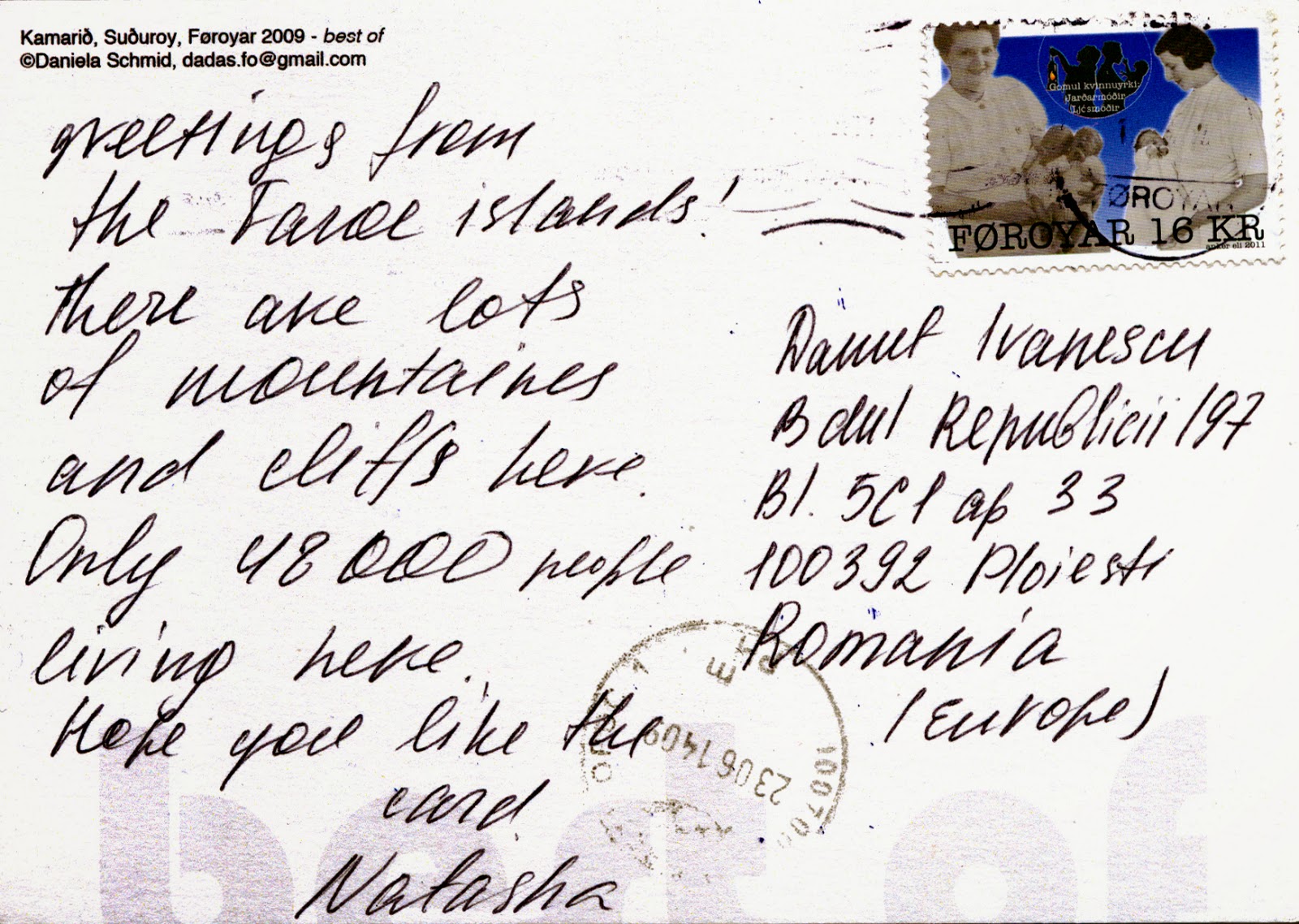
1138 DENMARK (Faroe Islands) - Kamarið Cliff in Suðuroy


Covering 163.7 square kilometres and being inhabited by 4,678 people, Suðuroy (literally South Island) is the southernmost of the Faroe Islands. It is the island which has the most islets and skerries (263), and also the only of the 18 islands of the Faroes which has a coalmine still active. The highest point of Suðuroy is the mountain Gluggarnir (610m), but the most famous peak is definitely the mountain of Beinisvørð north-west of the village of Sumba. The Beinisvørð and its scenery have been praised by the local poet Poul F. Joensen (1898–1970), as well as other Faroese poets. The western side of the island has been identified as an Important Bird Area by BirdLife International because of its significance as a breeding site for seabirds, especially Northern Fulmars, European Storm Petrels, European Shags, Black-legged Kittiwakes, Atlantic Puffins, Common Guillemots and Black Guillemots. On the postcard is Kamarið (The Chamber), near the village Vágur, situated on the east coast of the island on the Vágsfjørður fjord.

March 29, 2013

0579 DENMARK (Sjælland) - Roskilde Cathedral (UNESCO WHS)


After uniting the Danes and Norwegians, around the year 960, King Harald Bluetooth moved his capital closer to the new kingdom's centre of power, to Roskilde, on the island of Zealand, where it remained until 1443. Around 1160 the bishop Absalon decided the building of a Romanesque cathedral on the site of the old one, on the top of a hill, with a great view over the fjords. Absalon's successor embraced the new French Gothic style, so he made significant changes to the plans. With the exception of the two towers on the west facade, finished in 1405, the cathedral was completed in 1280, several chapels being added afterwards. The city's importance is evident from the fact that the Roskilde Domkirke (Roskilde Cathedral) was the only cathedral in Zealand until the 20th century.

December 9, 2012

0408 DENMARK (Hovedstaden) - The Little Mermaid


Everyone knows the fairytale The Little Mermaid by the Danish author Hans Christian Andersen. Unfortunately many actually know the animated musical fantasy film produced by Walt Disney Feature Animation in 1989, which, as all the productions of this kind, presents an embellished version of the original. The story has nothing cheerful, and the end is tragic. In short, a young mermaid fell in love with a prince who lived on the shore, and to get married with him, she appeals to a witch, who transforms his fishtail into legs. This sacrifice, which removed her from the aquatic world, was anyway useless, because the prince married a daughter of a neighboring king. She could have become again mermaid, if she would have killed the prince, but she didn't do so, but decided to sacrifice herself again, throwing herself into the waves.

September 8, 2012

0317 DENMARK (Greenland) - National Museum in Nuuk


"In the summer Eirik went to live in the land which he had discovered, and which he called Greenland, Because, said he, men will desire much the more to go there if the land has a good name." Thus is described in the Saga of Erik the Red the way that received the current name the world's largest island, located between the Arctic and Atlantic Oceans. A marketing strategy that has succeeded somewhat to Erik Thorvaldsson (950-1003), known better as Erik the Red, a Icelander from norwegian parents, exiled for three years for murder, who founded the first Norse settlement in Greenland (on the west coast) in 986 AD.

April 20, 2012

0180 DENMARK (Hovedstaden) - Kronborg Castle (UNESCO WHS)


"But what is your affair in Elsinore?" asks Hamlet in the first act of the play. "Without any affair, my lord, I just received a postcard, as you see." I would answer him, if he could hear me. Indeed, Elsinore is the version used by Shakespeare for Danish Helsingør, now a city on the northeast coast of the island of Zealand in eastern Denmark, where is located the Kronborg castle, the one in the image, included on the list of UNESCO World Heritage Sites in 2000. In this castle takes place the action of the famous play, which was performed in it for the first time to mark the 200th anniversary of the death of Shakespeare, with a cast consisting of soldiers from the castle garrison. The play has since been performed several times in the courtyard and at various locations on the fortifications. Later performers to play Hamlet at the castle included Laurence Olivier, John Gielgud, Christopher Plummer, Derek Jacobi, and in 2009 Jude Law. Every summer the outdoor courtyard of castle hosts this theatre festival, usually a homage to Shakespeare.

February 3, 2012

0114 DENMARK (Faroe Islands) - ...bygði þenna stað fyrst (...lived in this place first)


I received this wonderful maxicard issued by Faroe Islands from Kajo, which is Finnish and apologizes that had no maxicard from his country within reach and therefore he sent me this one. No problem, Kajo, the maxicard looks so good, that I make an exception, so to speak. And how an exception is followed, as is well known, by another, the maxicard arrived to me in envelope, so it wasn't circulated normally, as I like it. But if you look on her back, you will notice that couldn't otherwise, so this exception isn't even an exception.

November 10, 2011

0033 DENMARK (Hovedstaden) - A street called Strøget


The wet asphalt's gloss, the sunset extinguishing at the end of the street, the bicycles frozen in the middle of a dance, the almost empty street guarded by old buildings, suggesting the Germanic spirit, an unknown place, but a known feeling, all these things made me want to have this postcard. Behold I have it, and the way in which I have received it also delighted me, because, after I asked her, Daria said to me: "I understand what kind of postcards you want from me. I'll send one soon. If you would like to respond and send a postcard to me, I'll be glad to receive it. You can take a look at my profile and wishlist. You'll find my address on the postcard I'm going to send to you." Yes, in such moments, even I, with my misanthropic tendencies, can be convinced that the people are wonderful.