|
| 2712 Princely Church of Saint Nicholas in Curtea de Argeş |
Located on the right bank of the
Argeş River, where it flows through a valley of the lower
Carpathians (the
Făgăraş Mountains),
Curtea de Argeş (literally The Court upon Argeş), capital of
Wallachia in 14th and 15th centuries, retains Romanian representative monuments of medieval architecture. A first set consist in the Princely Church Saint Nicolas, the ruins of the
Princely Court (13th-16th centuries) and the Church Saint Nicoară (15th century). The second objective is the church of the former Argeş Monastery (1512-1517), an architectural archetype for a series of monastic buildings until the 18th century.
 |
2713 Princely Church of Saint Nicholas
in Curtea de Argeş - Deisis (detail proskynesis
- Nicholas Alexander Basarab) |
Founded by
Basarab I (r. 1310-1352), the founder of the independent feudal state of Wallachia, the
Princely Church of Saint Nicholas was built in
Byzantine style, after a plane of the type
Greek cross, version Constantinople, ending with three apses to the east. The outside look is defined by the alternation of stone and brick layers. For many decades, the church was also a necropolis for the crowned heads of Wallachia, being the burial place of
Vladislav I (r. 1364-1377) and
Radu I (r. 1377-1383). The paintings covering the walls date back to voivode Vladislav I, but some of them are from the 18th century.
 |
2714 Princely Church of Saint Nicholas
in Curtea de Argeş - Radu I and Lady Ana |
The over 300 original painting from the 14th century represent one of the most valuable examples of Byzantine art in south-eastern Europe, the works being impossible to categorize into one school of thought or one art genre. One of the walls bears a painting unique in the world that depicts the
Virgin Mary pregnant. Other frescoes presents scenes from the life of
Saint Filofteia, the saint whose relics were brought to the Princely Church in 1396. The relics remained in the place of worship until 1894 when they were moved to Curtea de Arges Monastery.
 |
| 2715 Cathedral of Curtea de Argeş |
The
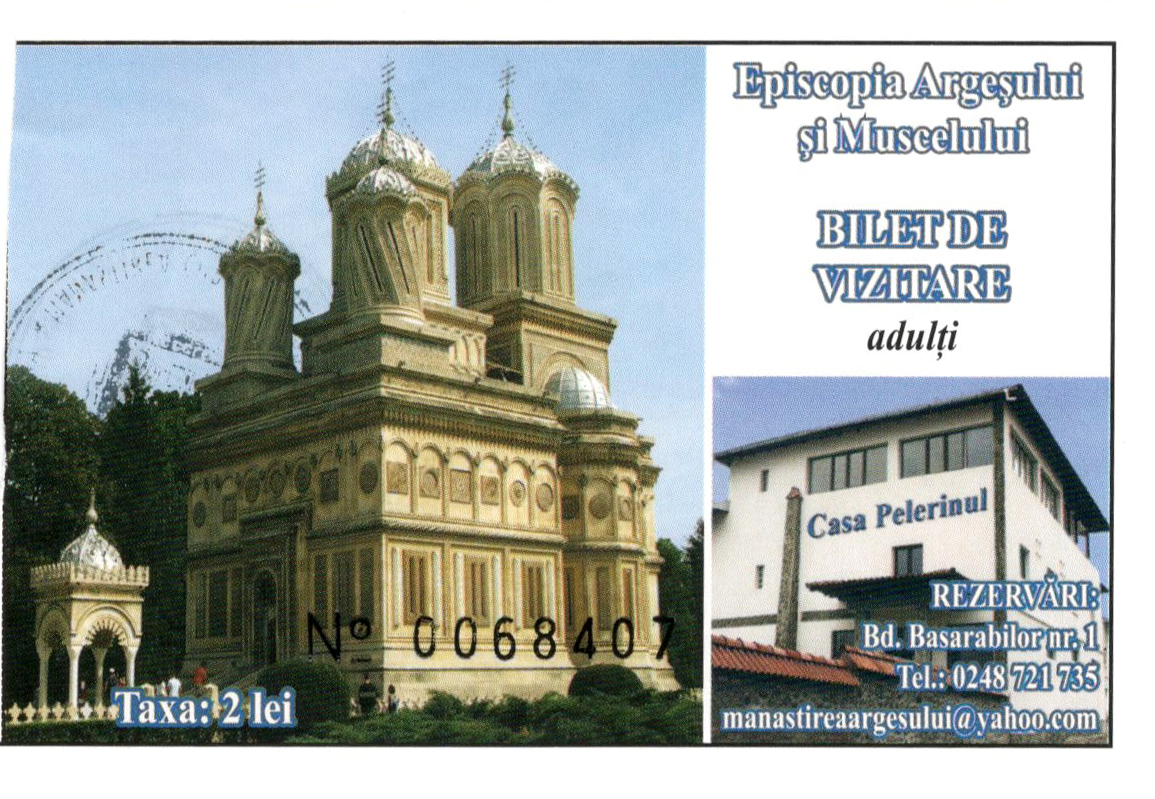
Cathedral of Curtea de Argeş, dedicated to the Assumption of the Virgin, resembles a very large and elaborate mausoleum, and was built in the Byzantine style, with Moorish arabesques. In shape the structure is oblong, with a many-sided annex at the back. A dome rises in the center, fronted by two smaller twisting and leaning cupolas, while a secondary dome springs from the annex. Each summit is crowned by an inverted pear-shaped stone, bearing a triple cross, emblematic of the
Trinity. Facing the main entrance is a small open shrine, consisting of a cornice and dome upheld by four pillars.
 |
| 2716 Cathedral of Curtea de Argeş - Mircea the Elder |
The church was built in three years (1515-1517), by
Neagoe Basarab, and the paintings inside were executed in 1526 by Master Dobromir during the reign of
Radu of Afumaţi. The later damage caused by people, fired and earthquakes was mended in 1682 by
Şerban Cantacuzino. Following another fire, the last restoration was made between 1875 and 1886 under the lead of the French
André Lecomte du Nouy, who made questionable changes. Near the church is the
well of Master Manole, the builder of the church, the hero of the ballad of the same name.
 |
| Cathedral of Curtea de Argeş - ticket |
As a curiosity, the nave and the narthex are not separated by a door, but by the frame of a door, placed between two columns. In the narthex are the graves of Neagoe Basarab (d.1521), his wife, Despina (d.1554), and his daughter, Stana (d.1531), Radu of Afumaţi (d.1529). Other tombs in the monastery are the final resting places for other four important royal heads of Romania: King
Carol I (d.1914) and his wife Queen
Elisabeta (d.1916), King
Ferdinand I (d.1927) and his wife Queen
Maria (d.1938).