Showing posts with label Europa stamps 2012 - Visit.... Show all posts
June 14, 2017
3086 HUNGARY (Bács-Kiskun) - The traditional costume of Kalocsa region
The Kalocsa is a marshy but highly productive district, on the left bank of the Danube River, in south central Hungary, and forms part of the cultural area known as the Great Hungarian Plain. Although is not very large, it has developed a beautiful form of very colorful embroidery which is often considered to be representative of Hungary. This handicraft was born in the second half of the 19th century, and originally the needlework was only white and the embroidery patterns were merely made up by holes.
Etichete:
EU - EUROPE,
EU-Hungary,
Europa stamps 2012 - Visit...,
HUNGARY
Locaţia:
Kalocsa, Ungaria
June 4, 2017
3077 GEORGIA - The map and the flag of the country
Located in the Caucasus region, at the crossroads of Western Asia and Eastern Europe, Georgia is bounded to the west by the Black Sea, to the north by Russia, to the south by Turkey and Armenia, and to the southeast by Azerbaijan. The capital and largest city is Tbilisi, founded in the 5th century AD by Vakhtang I Gorgasali, the monarch of the Kingdom of Iberia, on the banks of the Kura River. The country is divided into 9 regions, 1 city, and 2 autonomous republics, but de facto Abkhazia and South Ossetia declared independence from Georgia.
Locaţia:
Georgia
July 15, 2016
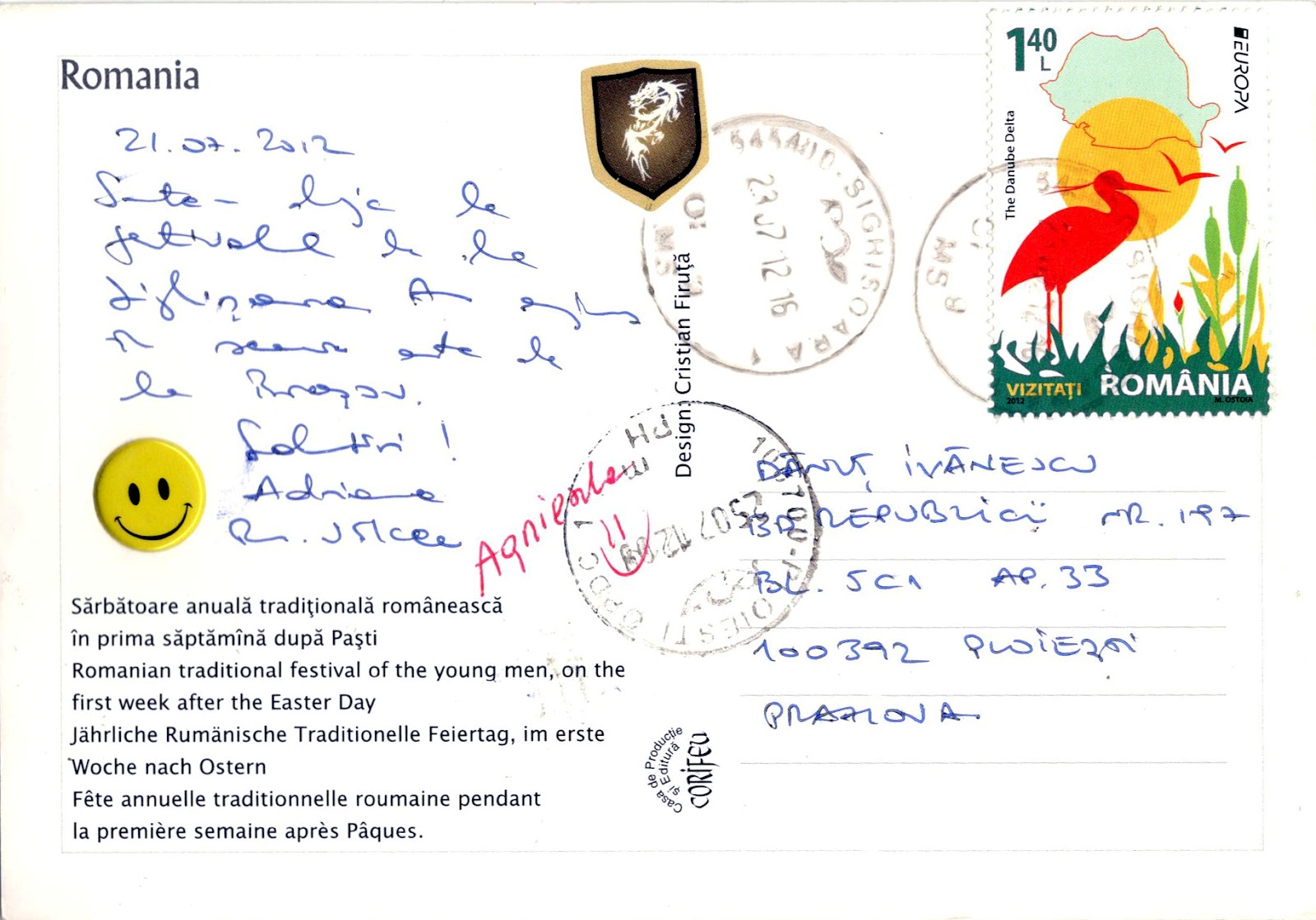
2649, 2650 ROMANIA (Brasov) - Junii Braşoveni (The Brasovian Lads)
![]() |
| 2649 Braşov - Junii Braşoveni (The Brasovian Lads) |
When the heavy snows of the harsh Brașovian winters are gone and spring sun shines again, it is the time for people from Şcheii Brasovului, the old Romanian district of Braşov, to start celebrating the renewal. Yearly, they have a festival, called The Brasovian Lads - Junii Brasoveni (In Transylvania, june means unmarried young lad) which stretches over weeks, having its climax on the first Sunday after Easter (when the Orthodox Christians Romanians celebrate Duminica Tomii - The Sunday of Thomas the Apostle).
![]() |
| 2650 Braşov -Junii Tineri in 1905 |
In
that day, a group of horsemen from Şchei, in nowadays with ceremonial
role, parade through the streets of Brașov, in specific costumes. Feast
is a complex of habits that combines pre-Christian and Christian
practices, to restore the myth of ritual death and rebirth of the
calendar time. The oldest document recorded in which this procession is
mentioned is from 26 March 1728 but it is assumed that the celebration
already existed in antiquity.
Etichete:
EU - EUROPE,
EU-Romania,
Europa stamps 2012 - Visit...,
ROMANIA,
ROMANIA (Braşov),
stamps (complete series)
Locaţia:
Brașov, România
August 11, 2015
0791, 1809 LIECHTENSTEIN - Vaduz Castle
![]() |
| 0791 LIECHTENSTEIN - Vaduz Castle |
Posted on 12.08.2013, 11.08.2015
Vaduz, the capital of the principality of Liechtenstein, is located along the Rhine, and has about 5,100 inhabitants. Mentioned in 12th-century manuscripts as Farduzes, it seems that was founded circa 1322 by the Counts of Werdenberg. In 1719 Charles VI, Holy Roman Emperor, decreed the unification of Vaduz and Schellenberg, and raised the new structure to the dignity of Fürstentum (principality), with the name Liechtenstein, in honour of "(his) true servant, Anton Florian of Liechtenstein". The most prominent landmark of the city is Vaduz Castle, the home of the reigning prince of Liechtenstein and the Liechtenstein princely family. The castle is visible from almost any location in Vaduz, being perched atop a steep hill in the middle of the city.
![]() |
| 1809 LIECHTENSTEIN - Vaduz Castle and the coat of arms of Liechtenstein |
The earliest mention of the castle dates from 13th century, but it was certainly built long time before. The Bergfried (the keep) was erected in 12th century, and parts of the eastern side are the oldest. The chapel of St. Anna, with a main altar in late-Gothic style, was presumably built in the Middle Ages. In the Swabian War of 1499, the castle was burned by the Swiss Confederacy, but it was rebuild, and the western side was expanded by Count Kaspar von Hohenems (1613-1640). The Princely Family of Liechtenstein acquired Vaduz Castle in 1712. It underwent a major restoration between 1905 and 1920, then again in the early 1920s, and was expanded during the early 1930s. The castle isn't open to the public, because the princely family still lives in it.
Etichete:
Europa stamps 2012 - Visit...,
Europa stamps 2014 - National Musical Instruments,
LIECHTENSTEIN,
Maps & flags,
Mountains,
Palaces / Castles / Fortress,
stamps (complete series)
Locaţia:
Castle Vaduz, 9490, Liechtenstein
May 5, 2015
1566 GEORGIA (Mtskheta-Mtianeti) - Historical Monuments of Mtskheta (UNESCO WHS)
![]() |
| 1566 Jvari Monastery |
Located at the confluence of the Aragvi and Mtkvari Rivers, Mtskheta was the ancient capital of Iberia, the East Georgian Kingdom from the 3rd century BC to the 5th century AD, and was also the location where Christianity was proclaimed as the official religion of Georgia in 337. To date, it still remains the headquarters of the Georgian Orthodox Church, and it was declared as the "Holy City" by the GOC in 2014. The favourable natural conditions, its location at the intersection of trade routes, and its close relations with the Roman Empire, the Persian Empire, Syria, Palestine, and Byzantium, generated the development of the city and led to the integration of different cultural influences with local cultural traditions.
Etichete:
Europa stamps 2012 - Visit...,
GEORGIA,
Places of worship,
stamps (complete series),
UNESCO World Heritage Sites
Locaţia:
Mtskheta, Georgia
November 21, 2013
0348, 0871 SWITZERLAND / AUSTRIA - Prehistoric pile dwellings from the Alps (UNESCO WHS)
![]() |
| 0348 SWITZERLAND - Reconstruction of a prehistoric pile dwelling from Bronze Age at Laténium, Hauterive. |
Among the sites included in 2011 by UNESCO in its list of World Heritage Sites is one called Prehistoric Pile dwellings around the Alps, which contains, as say its name, pile-dwelling settlements in and around the Alps, built on the edges of lakes, rivers or wetlands. So far have been identified 937 such sites, of which UNESCO has chosen 111, located in Austria (5), France (11), Germany (18), Italy (19), Slovenia (2), and Switzerland (56).
![]() |
| 0871 AUSTRIA - Computer animation of some prehistoric pile dwellings, which are nowadays on the bottom of the Keutschacher See, Carinthia. |
These settlements were built between 5,000 and 500 BC, i.e. during Neolithic and Bronze Age, a period about which we know little, but for which clarification would be an important step in finding our origins as Europeans. For now it is clear that at the end of the Neolithic has occurred a profound transformation, due to the penetration in Europe of a Proto-Indo-European populations wave, named by Marija Gimbutas Kurgan Culture. Equally clear is that these populations, more warlike and technologically superior to the ones found in Europe, were imposed and caused a cultural leap.
March 26, 2013
0577 SLOVAKIA (Banská Bystrica) - Historic Town of Banská Štiavnica and the Technical Monuments in its Vicinity (UNESCO WHS)
Located in the middle of an immense caldera created by the collapse of an ancient volcano, Banská Štiavnica was a mining settlement since the time of the Celts (3rd century BC), being occupied afterwards by Romans, and then by the early Slavs, in 1156 the site being called terra banensium (the land of miners). Starting with 13th century skilled German settlers were joined the Slavic population, adopting for settlement the name Schemnitz.
Etichete:
Europa stamps 2012 - Visit...,
Palaces / Castles / Fortress,
Places of worship,
SLOVAKIA,
stamps (complete series),
UNESCO World Heritage Sites
Locaţia:
Banská Štiavnica, Slovakia
February 27, 2013
0529 PORTUGAL (Madeira) - Spectacular Funchal Harbour
The first territorial discovery of the Portuguese Age of Discovery (1419), Madeira is a archipelago located in the north Atlantic Ocean, at 400km north of Tenerife, Canary Islands. Since 1976, the three islands of the archipelago (Madeira, Porto Santo, and the Desertas) form, together with Savage Islands, one of the two Autonomous regions of Portugal (the other being the Azores), currently the second richest region of the country, after Lisbon. Noted for its wine, flowers, landscapes and embroidery artisans, as well as for its annual New Year celebrations that feature the largest fireworks show in the world, Madeira is a popular year-round resort.
Etichete:
Europa stamps 2012 - Visit...,
MADEIRA,
PORTUGAL
Locaţia:
Funchal, Portugal
January 7, 2013
0062, 0451 ANDORRA - Romanesque churches of Andorra (UNESCO WHS - Tentative List)
![]() |
| 0062 Sant Miquel d'Engolasters Church |
It is known, the buffer zones located between the great powers were constantly exposed to invasions and excesses of all kinds. Principality of Andorra is a rare and happy exception, its borders remaining virtually unchanged since 1278, when the conflict between Count of Foix and the Bishop of La Seu d'Urgell was resolved by the signing of a paréage, which provided that its sovereignty will be shared between these two. The period which preceded this agreement (between 9th and 13th centuries) was one intense from political point of view, but also artistic. Among the major achievements of this period are several Romanesque churches, eight of them being included on the Tentative List of UNESCO WHS.
![]() |
| 0451 Sant Joan de Caselles Church |
Sant Miquel d'Engolasters Church, built before the 12th century in a strategic spot with a fabulous panoramic view out over the capital Andorra la Vella, the church invites visitors to head to Engolasters Lake or the valley of Madriu-Perafita-Claror, a UNESCO WHS since 2004. The rectangular design houses a nave, a semi-circular apse, a gable roof, a belfry and a later arcade porch. The building is characterised by the disproportion between the nave and the 17m high belfry. The top floor of the belfry preserves one of the few Romanesque sculptural pieces in Andorra - carved heads in the centre of the double window arches - and the interior houses reproductions of the Romanesque mural paintings by the master artist of Santa Coloma (12th century), now held by the National Art Museum of Catalonia.
Etichete:
ANDORRA,
Europa stamps 2011 - Forests,
Europa stamps 2012 - Visit...,
Places of worship,
stamps - Christmas & New Year,
stamps (complete series),
UNESCO World Heritage Sites (tentative)
Locaţia:
Andorra
Subscribe to:
Posts (Atom)


.jpg)