Showing posts with label POLAND. Show all posts

January 15, 2020

1023, 3358 POLAND (Greater Poland) - Traditional Bamberka costume

1023

Posted on 06.03.2014, 15.01.2020
Located on the Warta river, Poznań was an important cultural and political centre with centuries before the Christianization of Poland, becoming later the capital of Wielkopolska (Greater Poland), and, for a short time, even the capital of the kingdom. After a long time of prosperity, in the 17th and 18th centuries the city was severely affected by a series of wars, plagues and floods, which practically depopulated it. Following, in area were brought, in several waves, Dutch and Bambergian settlers, exclusively Catholics, as ordered in 1710 August II the Strong, Elector of Saxony, King of Poland and Grand Duke of Lithuania.

3358
 

The polonisation of the latter ones, subsequently named Bambrzy, was a voluntary act and happened very quickly. In the late 19th century, the meaning of the word Bamber (singular form) became wider, designating all the people living in those villages, regardless of their ethnic or cultural background. Of course that the settlers had their own folk costume, quite modest, but in the second half of the 19th century this was changed into a rich impressive outfit full of decorative pieces. So it must be emphasized that the folk dress of the descendants of these immigrants it wasn't brought by them from Bamberg, but was developed here. It should be also noted that it is about women's dress, the men adopting quickly the typical clothes of the locals.

February 3, 2018

3258 POLAND (Lesser Poland) - International Postcrossing Meetup, Kraków, January 8, 2018


The first Polish Postcrossing meetup in 2018 occured on 8 January in Kraków, in Kazimierz district, somewhere near Q Hotel Plus, starting 4:30 afternoon. The special postcard issued with this occasion depicts Saint Mary's Basilica (Church of Our Lady Assumed into Heaven) seen from Sukiennice (Kraków Cloth Hall), across the Main Market Square in Kraków. This square is one of the four core areas of Historic Centre of Kraków, an UNESCO World Heritage Site about which I wrote here.

January 28, 2018

3252 POLAND (Podlaskie) - The Augustów Canal (UNESCO WHS - Tentative List)


The Augustów Canal (Kanał Augustowski) is a cross-border canal built in the 19th century in the present-day Podlaskie Voivodeship of northeastern Poland and the Grodno Region of north-western Belarus (then the Augustów Voivodeship of the Kingdom of Poland). From the time it was first built, the canal was described by experts as a technological marvel, with numerous sluices contributing to its aesthetic appeal. The completed part of the canal remained an inland waterway of local significance until rendered obsolete by the regional railway network.

December 8, 2017

1571, 3213 POLAND (Mazovia) - Palace of Culture and Science in Warsaw

1571

Posted on 10.05.2015, 08.12.2017
With its 231m height (which includes a 43m high spire), the Palace of Culture and Science is the tallest building in Poland and the eighth tallest building in the European Union. Built in three years according to the design of the Soviet architect Lev Rudnev, almost entirely by 3500 workers from the Soviet Union, the structure was conceived as a "gift from the Soviet people to the Polish nation", and was completed in 1955. The building was originally known as the Joseph Stalin Palace of Culture and Science (Pałac Kultury i Nauki imienia Józefa Stalina), but in the wake of destalinization the dedication to Stalin was revoked.

3213

Architecturally, it is a mix of Stalinist architecture, also known as Socialist Classicism, and Polish historicism inspired by American art deco skyscrapers. The monumental walls are headed with pieces of masonry copied from Renaissance houses and palaces of Kraków and Zamość. Currently it is the center for various companies, public institutions and cultural activities such as concerts, cinemas, theaters, libraries, sports clubs, universities, scientific institutions and authorities of the Polish Academy of Sciences.

November 3, 2017

3189 POLAND (West Pomerania) - Gąski Lighthouse


Located on the Polish coast of the Baltic Sea, next to the road between Ustronie Morskie and Mielno, Gąski Lighthouse was built between 1876 and 1878 from red bricks. The height of the lighthouse is 41.2m; with the lighthouse's light having a focal length of 50.1m. Originally it was fitted with a Fresnel lens with the light source provided by kerosene lamps. The intermittent beam was achieved by three screens rotated by a clock-work mechanism.

October 26, 2017

3179 POLAND (West Pomerania) - Kołobrzeg Lighthouse


Located on the Polish coast of the Baltic Sea, on the right bank of the river Parsęta, at the entrance to the port of KołobrzegKołobrzeg Lighthouse is 26m tall, with a range of its light glare of 29.6 km. Its history dates back to 1666. In WWII it was blown up by German engineers as it was a good look-out point for the Polish artillery in March 1945. After the war it was built at a slightly different location from the original, using the foundations of the fort buildings complex; located close by to the town.

October 25, 2017

3178 POLAND (Mazovia) - Warsaw

3178 Warsaw: 1. View of the Castle Square;
2. Łazienki Park - Palace on the Isle (south façade);
3. Wilanów Palace; 4. Dmowski Roundabout

The legend attributes the Warsaw name to a fisherman Wars and his wife Sawa, a mermaid who lived in the Vistula River and who Wars fell in love with. Nice legend, but actually Warsz was a 12th/13th century nobleman who owned a village located at the site of today's Mariensztat neighbourhood. Unlike other old cities of Poland, as Krakow or Poznan, Warsaw is a relatively young city, which really became important in 1596, when King Sigismund III Vasa moved the court from Kraków to Warsaw.

October 9, 2017

3166 POLAND (Greater Poland) - Pleszew Narrow Gauge Railway


Pleszew is a town located about 90 km southeast of Poznań. The 3km narrow gauge line from Pleszew Miasto (town) station to Pleszew Wąsk (narrow gauge) station (adjacent to Pleszew main line station in the village of Kowalew), is the surviving fragment of the 750mm gauge Krotoszyn District Railway, which ran from Krotoszyn to Broniszewice, via Pleszew (50km). This line (formally named the Krotoszynska Kolej Dojazdowa) dates back to 1900.

September 18, 2017

3153 POLAND (Podlaskie) / BELARUS (Grodno / Brest) - Białowieża Forest (UNESCO WHS)


The Białowieża Forest World Heritage site, on the border between Poland and Belarus, is one of the last and largest remaining parts of the immense primeval forest that once stretched across the European Plain. Situated on the watershed of the Baltic Sea and Black Sea, this transboundary property is exceptional for the opportunities it offers for biodiversity conservation. It is home to the largest population of the heaviest land animal of the continent, the European bison (Bison bonasus) (almost 25% of the total world's population).

September 10, 2017

3146 POLAND (Pomerania) - Hel Lighthouse


Situated at the eastern tip of the Hel peninsula, Hel Lighthouse guides ship traffic into Gdańsk Bay and the Bay of Puck. It has its origins in the 16th century when a fire was lit on the church tower at a height of 35m to guide ships. The structure burned down. In 1638 locals asked Gdańsk authorities to build a lighthouse on the peninsula. After deliberation, a wooden structure was erected circa 1640, with a range of about 6 miles. In 1667 it burned down, too. The construction of the first brick lighthouse (which was 41.7m high) started in 1806, but due to civil wars the effort dragged on until 1826.

August 27, 2017

3136 POLAND (Pomerania) - Ustka Lighthouse


Ustka Lighthouse is located in the town with the same name (formerly Postomino), on the Polish coast of the Baltic Sea. The lighthouse stands at the base of the eastern breakwater of Ustka's harbour - protecting the port's entrance way. Ustka was a very important coastal town for the nearby Słupsk - for transportation of goods and Baltic travel. In 1871 a mast was constructed nearby the harbour's admiralty station; powered by an oil lamp on the mast. It shone with a red light and was visible at a distance of 6 nautical miles.

August 22, 2017

3132 POLAND (West Pomerania) - Jarosławiec Lighthouse


Located on the coast of the Baltic Sea, in the village with the same name, between the Darłowo and the lighthouse in Ustka, Jarosławiec Lighthouse is the oldest lighthouse in Poland. Its construction began in 1835 however the lighthouse was not successful due to a number of physical factors. The lighthouse was built about 400m from the coast - this proved to be too low to be effective for navigation. Its light wasn't very visible because it was obscured by trees and it was soon decided to build a new tower closer to the beach.

August 14, 2017

3123 POLAND (Pomerania) - Gdansk New Port Lighthouse


Built in 1894, and operated continuously for more than 100 years, Lighthouse in Gdansk New Port is one of the most beautiful lighthouses on the Baltic Sea. It made history when, on 1st September 1939; shots fired from its windows were a signal for the battleship Schleswig-Holstein to commence the bombardment of the Polish Westerplatte, which signalled the start of World War II.

August 4, 2017

3116 POLAND (Mazovia) - Warsaw between 1767 and 1779 in the paintings of Canaletto


In 1569 was established the Polish-Lithuanian Commonwealth (a bi-confederation of Poland and Lithuania ruled by a common monarch, who was both the King of Poland and the Grand Duke of Lithuania), which became one of the largest and most populous countries of 16th- and 17th-century Europe. Due to its central location between the Commonwealth's capitals of Kraków and Vilnius, Warsaw became practically the capital of the Commonwealth in 1596, when King Sigismund III Vasa moved his court from Kraków to Warsaw (also the permanent seat of the General Sejm from the same year), although the modern concept of a single capital city was to some extent inapplicable in the feudal and decentralized Commonwealth.

March 11, 2017

2086, 2979 POLAND (Łódź) - Children from Łowicz in traditional dress

2086 Children from Łowicz in traditional dress (1)

Posted on 30.11.2015, 11.03.2017
The Łowicz region corresponds with the area of the former Łowicz Duchy, which nowadays covers the best part of Łowicz District. People from this region began to wear the charcteristic striped fabric in the 20's and 30's of the 19th century. A crimson background covered with verical sets of stripes dominated till the end of that century, then an orange background appears and the stripes are varied. In the inter-war period clothes are mainly navy blue and green.

2979 Children from Łowicz in traditional dress (2)

In the 19th century women from Łowicz region wore creased skirts made of striped woollen cloth, pleated aprons, bodices and jackets. In the 20th century bodices were more and more often made from black velvet and sewn together with the skirts, embroidered with threads and beads giving a splendid display of roses surrounded by other smaller flowers and leaves. The sleeves with embroidered cuffs were extremely baggy.

February 28, 2017

2486, 2967 POLAND (Pomerania) - Kashubian people

2486 Kashubian traditional dress

Posted on 23.04.201, 24.02.2017
Kashubians (Kashubian: Kaszëbi; Polish: Kaszubi; German: Kaschuben) are a West Slavic ethnic group in  Pomerelia, a historical region in northern Poland, located on the southern shore of the Baltic Sea and west of the Vistula river. They speak the Kashubian language, classified either as a separate language closely related to Polish, or a Polish dialect. Gdynia contains the largest proportion of people declaring Kashubian origin, but the biggest city and the traditional capital of Kashubia is Gdańsk.

2967 A Kashubian dance

Kashubians descend from the Slavic Pomeranian tribes, who had settled between the Oder and Vistula Rivers after the Migration Period, prior to the arrival of the Poles, and were at various times Polish and Danish vassals. Despite strong Germanization, Kashubian think about themselves as Poles, and the motto is "There is no Kashubia without Poles and Poland without Kaszubians". Today, in some towns and villages in Pomeralia, Kashubian is the second language spoken after Polish, and it is taught in regional schools.

November 30, 2016

0210, 2888 POLAND (Pomerania) - Gdansk, Town of Memory and Freedom (UNESCO WHS - Tentative List)

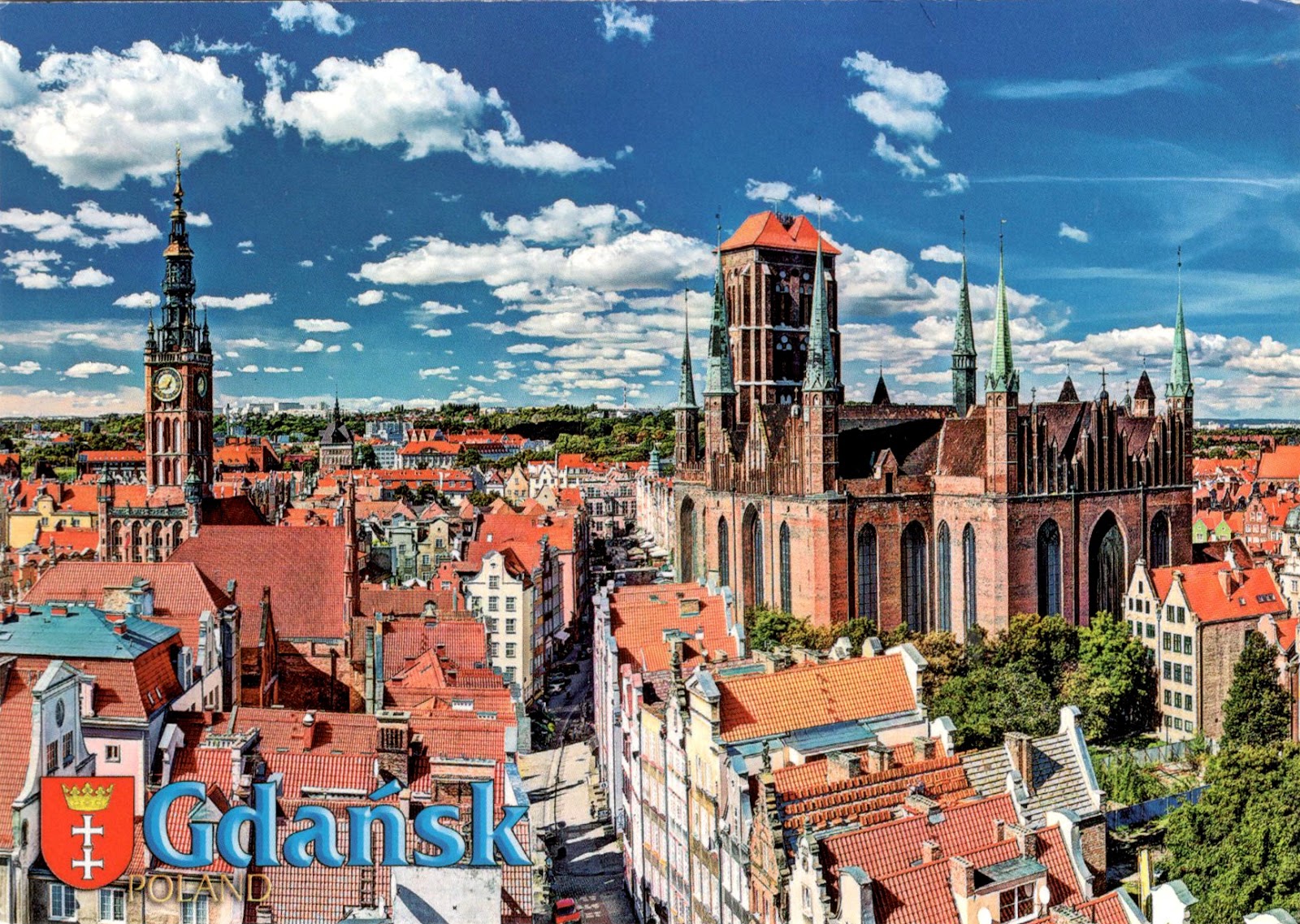
2888 Gdansk - The Main Town Hall and St. Mary's Church.

Posted on 18.05.2012, 30.11.2016
Built on the site of an early settlements associated with the Wielbark culture, which was followed in 980 by a stronghold, Gdańsk received city rights by Swietopelk II, in 1235. With permanent valences of a free city, due to its location on the Baltic Sea coast, to the mouth of the river Motława, which gives it a opening both towards the sea as well as towards central Poland, and from there towards Eastern Europe, the city belonged, successively, to the Kingdom of Poland, the Teutonic Knights, Polish-Lithuanian Commonwealth, Prussia, German Empire, German Reich, and Poland, except for two brief periods, when it was a free city (1807-1814, 1920-1939).

0210 Gdansk - The crane Żuraw

The stronghold and town of Gdansk contained from its beginnings a series of individual urban components which later became distinct districts within which there are valuable examples of urban, sacral and defensive architecture. These include the Main Town (Glowne Miasto), Old Town (Stare Miasto), the Lower Town (Dolne Miasto), the Old Suburbs (Stare Prdedmiejscie), Granary Island (Wyspa Spichrzow), Olowianka, Long Gardens (Dlugie Ogrody), Bishpop's Hill (Biskupia Gorka) and Grodzisko.

October 2, 2016

2791 POLAND (Kujawy-Pomerania) - Medieval Town of Toruń (UNESCO WHS)


The Medieval Town of Toruń was established on the site of a former Slavic trading town that had existed for around 500 years and dates to the 13th century, when the city of Toruń (Thorn) was granted a town charter by the Teutonic Knights Hermann von Salza and Hermann Balk in 1233. The town, initially composed primarily of the district now known as the Toruń Old Town and the Toruń Castle, developed as a major commercial center, and was one of the key members of the Hanseatic League. As the town quickly grew, the Toruń New Town developed from 1264 east of the Old Town and north of the castle.

September 11, 2016

2748 POLAND (Lesser Poland) - Kalwaria Zebrzydowska: the Mannerist Architectural and Park Landscape Complex and Pilgrimage Park (UNESCO WHS)


With a vision while viewing the neighbouring hills and valleys from the Castle of Lanckorona, on 1 December 1602, Mikołaj Zebrzydowski, the Voivode of Kraków commissioned the construction of a calvary, i.e. Roman Catholic monastery and the trails of the Passion of Christ modeled on the Calvary outside the city walls of Jerusalem. The town takes its name from the monastery and the last name of its founder Zebrzydowski. The town of Zebrzydów was established in 1617 in order to house the growing number of pilgrims visiting the Roman Catholic site of worship.

September 6, 2016

2740 POLAND - The lighthouses on the Baltic Coast of Poland


Since the end of WWII, the coast of Poland has stretched from Świnoujście in the west to the Gulf of Gdańsk in the east. Poland has at least 26 lighthouses on its Baltic coast and also many others on the inland waterway. All of the Polish coastline was under German control from the 18th century through the end of WWI. Poland became independent of Germany and Russia as a result of WWI, but between the two world wars its coastline was only a narrow "corridor" at Gdynia.