Showing posts with label CHILE. Show all posts

May 8, 2016

2533 CHILE - Marraqueta


The marraqueta (a soft bread made with flour, salt, water and yeast, with a crunchy texture) is the most widely consumed bread in Chile. It is, strictly speaking, a se-tenant pair of small rolls, baked with another pair attached, comprising four rolls in total; some confusion can be caused when ordering one marraqueta, as this may be interpreted as either two or four rolls. It is also popular in Bolivia and Peru, but can be found as well in Argentina and Uruguay. It is called pan francés (French bread) in the south of Chile and pan batido (whipped bread) in the Valparaíso Region.

December 24, 2015

2143 CHILE (Arica y Parinacota) - Lauca National Park


Located in Chile's far north, in the Andean range, Lauca National Park encompasses an area of 1,379 km2 of altiplano and mountains, and borders Las Vicuñas National Reservee and  Sajama National Park in Bolivia. One of the main attractions of the park is the small lacustrine area formed by Chungará and Cotacotani lakes, which lies at the foothills of the Payachata volcanic group.

September 30, 2015

1926 CHILE (Magallanes y la Antártica Chilena) - Torres del Paine and Bernardo O'Higgins National Parks, Region of Magallanes (UNESCO - Tentative List)

1926 - Torres del Paine National Park

Located in a transition area between the Magellanic subpolar forests and the Patagonian Steppes, Torres del Paine National Park encompass mountains, glaciers, lakes and rivers. Paine means "blue" in the native Tehuelche (Aonikenk) language and is pronounced PIE-nay. The Torres del Paine are the distinctive three granite peaks of the Paine mountain range or Paine Massif. They extend up to 2,500m above sea level, and are joined by the Cuernos del Paine.

August 19, 2015

1834 CHILE (Antofagasta) - Paso de Jama in Altiplano


The Altiplano (the high plain), located in west-central South America, where the Andes are at their widest, is the most extensive area of high plateau on Earth outside of Tibet. Its bulk lies within  Bolivian and Peruvian territory while its southern parts lie in Chile and Argentina. Dominated by massive active volcanoes of the Central Volcanic Zone to the west, and the Cordillera Real in the north east, it has a height averages about 3,750m. The part which belongs to Chile and Argentina, arid and bleak, is known as the Puna de Atacama. The Central Andean dry puna, part of the Puna grassland, has a cold desert climate, its flora being dominated by species of the genera Stipa and Festuca.

August 12, 2015

1812 CHILE (Antofagasta) - Licancabur volcano


Located on the southernmost part of the border between Chile and Bolivia, just southwest of Laguna Verde in Bolivia, Licancabur (5,916 m), a highly symmetrical stratovolcano, dominates the landscape of the Salar de Atacama area. The lower two thirds of the northeastern slope of the volcano belong to Bolivia, while the rest and biggest part, including the crater, belong to Chile. It contains Licancabur Lake, one of the highest lakes in the world, which is ice-covered most of the year. He didn't erupted in the last 500-1000 years. The word Licancabur is the Castilianization of a Kunza name used by the Atacameño Likan-antay people to refer to the volcano: lican (people) and cabur (mountain), thus meaning "Mountain of the People".

March 8, 2014

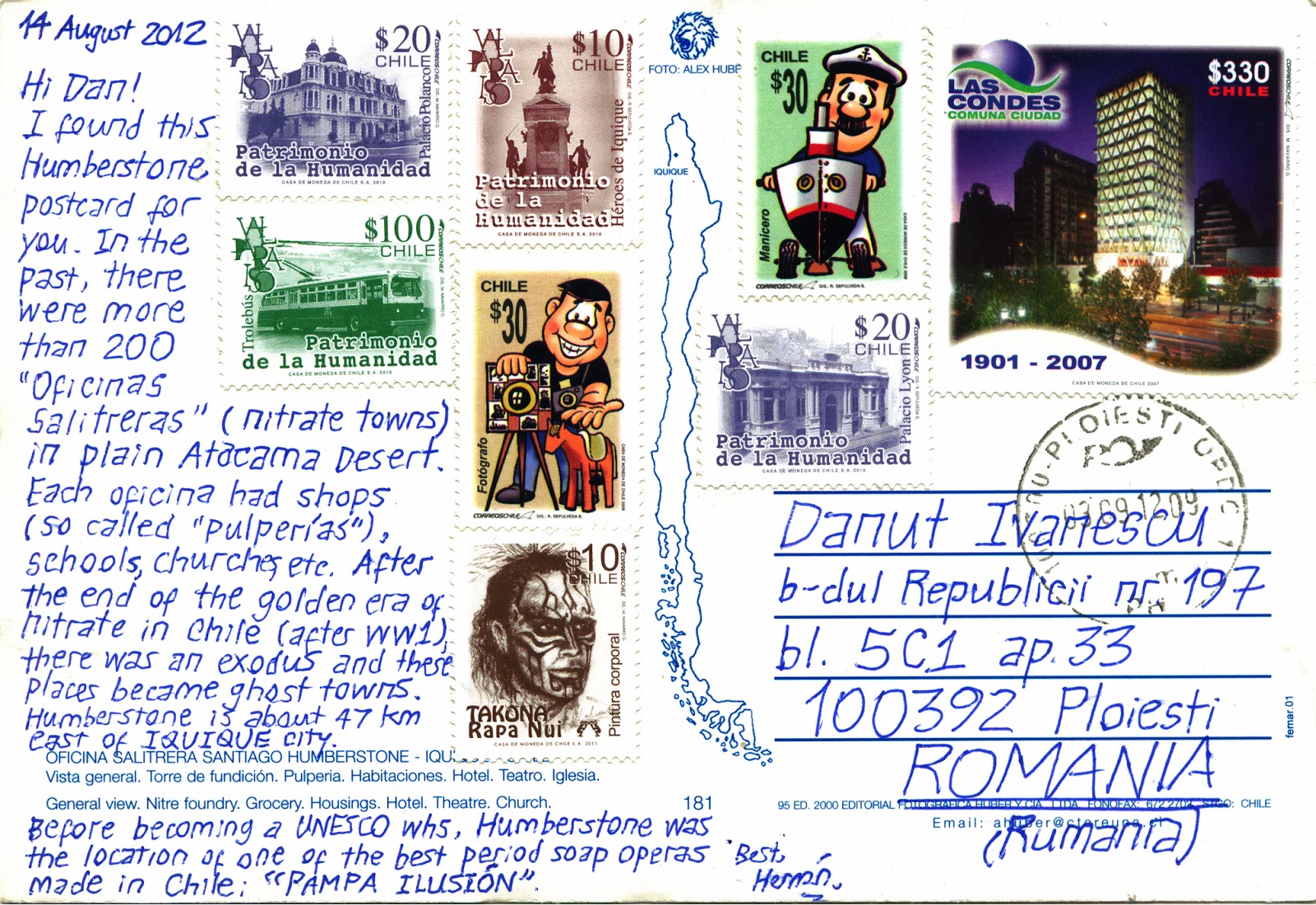
1027 CHILE (Tarapacá) - Humberstone and Santa Laura Saltpeter Works (UNESCO WHS)


The gunpowder is only a simple mix of sulphur, charcoal and saltpeter, but it is known how much it influenced our history. Well, among the three ingredients, the last was the hardest to obtain until the 20th century. Derived as name from the Latin sal petrae (salt of the rock), the saltpeter is a nitrate salt (of calcium, potasium or sodium), used also as fertilizer and food preservative. The calcium nitrate (Norwegian saltpeter) forms an efflorescence where the manure comes in contact with the limestone in a dry environment as in stables or caverns. The potassium nitrate (niter, Chinese snow, or India salpeter) occurs also as a crust on the soil and on the surface of rocks in dry climates and in the soil of limestone caves. Both were therefore rare. In this context, you realize what it meant to Chile and Peru the discovery in the Atacama desert of some deposits of sodium nitrate (nitranite) covering immense areas. The accumulations were so big, that this mineral was named Chile saltpeter or Peru saltpeter.

October 28, 2013

0852 CHILE - Qhapaq Ñan, Andean Road System (UNESCO WHS)


It is known that the Inca road system was the most extensive and advanced transportation system in pre-Columbian South America. The network was based on two north-south roads with numerous branches, the best known portion of it being the trail to Machu Picchu. Part of the roads was built by cultures that precede the Inca Empire, notably the Wari culture, and during the Spanish colonial era parts of this system were given the status of Camino Real (Royal Road). Imagine stone paving up to 20m wide, dressed steps climbing heights of over 4500m, walkways over water and suspension bridges spawning raging rivers. Envision single runners, chasquis, carrying messages on knotted strings called quipus at lightening speed in relay from one end of the empire to the other or imagine thousands of troops marching in line, their footsteps thundering in approach. Or visualize the Inca himself, seated on a litter lined with feathers and plated with gold and silver, being carried by more than 80 lords, the road before him being swept and adorned with petals.

October 15, 2013

0841 CHILE - La Cueca


By Decree No. 23 published in the Official Journal on 18 September 1979, cueca became the national dance of Chile. Among other arguments, the main was that within the wide range of Chilean folk dances, this had the highest level of diffusion and historical significance. Their presence can be recognized throughout the country, varying the choreographic and musical forms as the geographical area in which it is interpreted, but always keeping a common pattern that makes it a dance unique and differentiated. It has had two predominant functions: first, entertainment, bailándose in boarding and parties with great fanfare, secondly, the documentary function, as it acts as a transmitter of the oral tradition of popular singers voice.

March 10, 2013

0548 CHILE (La Araucanía) - Villarrica volcano


Known also as Rucapillán, which in Mapuche means "House of the Pillán", Villarrica is one of Chile's most active volcanoes, rising above the lake and town of the same name, in the Chilean Central Valley. It's one of only five volcanoes worldwide known to have an active lava lake within its crater, and usually generates strombolian eruptions, with ejection of incandescent pyroclasts and lava flows. Melting of snow and glacier ice as well as rainfalls often cause massive lahars (mud and debris flows), such as during the eruptions of 1964 and 1971.

February 28, 2013

0532 CHILE (Antofagasta / Atacama) - Penitentes from Puna de Atacama


Puna de Atacama (Atacama Plateau) is a cold Andean tableland in northwestern Argentina and adjacent regions of Chile, with a length of 320km (north to south), a width of 240km, and an average elevation of 4,500m. This region may be defined as the southernmost portion of the Andean Altiplano (Spanish for high plain) and is separated from the Atacama Desert by the Cordillera Domeyko. The peaks of the Cordillera Oriental alternate with dry, sandy, clay-filled basins, occupied by salt flats. Along its eastern margin, the plateau has been dissected by streams into deep, narrow river valleys, as well as broader valleys, important as colonial routes of penetration into the Argentine Andes. Peruvian and Chilean colonizers conducted expeditions through the Andean valleys in the latter half of the 16th century that led to the foundation of some of the oldest towns in Argentina. Before the War of the Pacific (1879-1883), the region belonged to Bolivia, but afterwards was ceded to Argentina (1898), and after the Puna de Atacama Lawsuit (1899) 85% from the disputed territory were awarded to Argentina and 15% to Chile.

January 8, 2013

0316, 0452 & 0453 CHILE - Pablo Neruda


I read the first poem by Pablo Neruda in 1986, in an anthology called Poetry and Humanity, which includes all the 20 poets who had received until then the Golden Wreath, the great award of the Struga Poetry Evenings, an international festival which takes place since 1966 in this little town located on the lakeside Ohrid, then in Yugoslavia, now in Macedonia. Honestly, I bought the volume for the poem of Nichita Stănescu, my illustrious concitadin, but I noted Pablo Neruda and Eugenio Montale even after first reading. And I noticed also a sad coincidence: both Pablo Neruda and Nichita Stănescu died one year after receiving the prize from Struga, at an interval of a decade, in 1972, respectively 1982.


On his real name Neftalí Ricardo Reyes Basoalto, Chilean poet who chose his pen name after Czech poet Jan Neruda had a very hectic life, occuping during his lifetime many diplomatic positions in Asia, Europe and Latin America, and being married three times. Acquiring the communist beliefs during the Spanish Civil War (at that time he was consul in Madrid), he served a stint as a senator for the Chilean Communist Party, but also lived many years in exile.


Although widely recognized as a great poet by his peers, he was often criticized for his admiration for Lenin, Stalin and Castro (In 1953 he was awarded the Stalin Peace Prize) and his political involvement too pronounced. Thus Gabriel García Márquez called him "the greatest poet of the 20th century in any language", but Jorge Luis Borges stated "I don't admire him as a man, I think of him as a very mean man", and Octavio Paz commented that he "became more and more Stalinist".

November 30, 2012

0399-0400 CHILE (Metropolitana de Santiago) - Cerro Santa Lucía


On 12 February 1541, the Spanish Conquistador Pedro de Valdivia founded, on a island of the Mapocho River, a settlement which he named it Santiago de Nueva Extremadura, as a homage to Saint James and Extremadura and in relation with the first name given to Chile, Nueva Extremadura (Extremadura, in Spain, was Valdivia's birthplace). The founding ceremony was held on Huelén Hill (in Mapudungun Huelén means "pain, melancholy or sadness"). Seven months later, on 11 September, the Picunche attacked Santiago, beginning a three-year-long war. On 13 December, day in which was celebrates Santa Lucia, Valvidia conquered the hill and renamed it after this saint. Even though is not the highest hill in town (it has only 69 meters hight, i.e. an altitude of 629 meters above sea level), the spaniards used it as an observation spot, to detect indigenous attacks.


Here were constructed the first hermitages, of the Virgin of Socorro in 1543, of Santa Lucia  and later San Saturnino. During Reconquests (1814-1817), the last Spanish governor, Don Casimiro Marco Del Pont, taking advantage of its strategic location, with ample dominion on the city and the valley, turned the place in bastion of the realistic defense. At his order, the Brigadier of the Royal Engineers Manuel Olaguer Feliú built two forts, on north and south of Santa Lucía Hill (Cerro Santa Lucía), the Marco Del Pont (later González Castle - Caupolicán Seat) and the Santa Lucia (Hidalgo Fortress), able to put eight or twelve cannons each. On the other side, the hillside terrain was used as a "cemetery for the dissidents", people who didn't follow the then-official Roman Catholic faith, or were considered otherwise unworthy of burial at hallowed grounds.

September 16, 2012

0333 CHILE (Libertador General Bernardo O'Higgins) - Sewell Mining Town (UNESCO WHS)


Situated in the Andes, on volcano Cerro Negro, at about 2100m high, 80km from Santiago and 60km to the east of Rancagua, in an environment marked by extremes of climate, Sewell is the site of the world’s largest underground mine, with about 1500km of galleries. Built by the Braden Copper company in 1905 to house workers at copper mine El Teniente, is, according to UNESCO, which designated it in 2006 a World Heritage Site, under the name Sewell Mining Town, "an outstanding example of the company towns that were born in many remote parts of the world from the fusion of local labour and resources from an industrialized nation, to mine and process high-value natural resources. The town was built on a terrain too steep for wheeled vehicles around a large central staircase rising from the railway station".

July 15, 2012

0279 CHILE (Los Lagos) - Osorno volcano


"It is even difficult to get a single glimpse of the Cordillera: during our first visit, once only the volcano of Osorno stood out in bold relief, and that was before sunrise; it was curious to watch, as the sun rose, the outline gradually fading away in the glare of the eastern sky," wrote Charles Darwin in his diary in 1834, during his famed voyage on the HMS Beagle, which is the first official mention of this stratovolcano lying between Osorno Province and Llanquihue Province, in Los Lagos Region of Chile.

May 30, 2012

0231 CHILE (Antofagasta) - In the land of the Atacameño


We all learned in school that the Atacama Desert is the driest place on earth. Maybe also the fact that it has an area about as a third of Poland. The average rainfall in the region of Antofagasta is just 1mm per year (for comparison, in Rome is 834 mm per year). It seems that the Atacama may not have had any significant rainfall from 1570 to 1971, and in a region about 100km south of Antofagasta, which averages 3,000m height, the soil is comparable to that of Mars.

March 30, 2012

0161 CHILE (Metropolitana de Santiago) - La Moneda Palace (UNESCO - Tentative List)


Santiago, Chile – March 29, 2012 (i.e. yesterday)
The Associated Press: "Bands of hooded youths clashed with police in Chile's capital Thursday during another round of riots on what has come to be known as the day of the combatant [more accurate Dia del joven combatienteDay of the Young Combatant]. Young people have been staging the violence every March 29 in memory of two youths [brothers Rafael and Eduardo Vergara Toledo] killed by police in 1985 during the dictatorship of Gen. Augusto Pinochet. Chile has been democratic for more than two decades and other activists criticized the rioting, saying the violence is used by Chilean news media and government officials to weaken support for movements pushing for social change. […] More than 1,500 police were deployed and used tear gas and water cannons to disperse hundreds of protesters from inside and outside the campus of the University of Santiago. The university suspended classes, and nearby traffic was snarled."

February 22, 2012

0129 CHILE (Valparaiso) - Historic Quarter of the Seaport City of Valparaíso (UNESCO WHS)


The second postcard sent by Hernán (gracias, amigo) shows Valparaiso, which played an important geopolitical role in the second half of the 19th century, when the city served as a major stopover for ships which traveled between the Atlantic and Pacific oceans by crossing the Straits of Magellan.  Cosmopolitan, exotic and colorful, the city was then called The Jewel of the Pacific (but also Pancho, diminutive form of Francisco), but the opening of Panama Canal in 1914 ended its golden age, even though it remained a vibrant center of Chilean culture.

January 15, 2012

0099 CHILE - Mapuche, people of the land


If sending postcards would be a profession, Hernán would be in the elite professionals and on his business card would be engraved the title magister chartum illustratae (or something like that). It's hard to describe the joy that I felt when I received the 3 postcards from him. Are exactly those that I wanted, and looks better than I hoped, which, you must admit it, rarely happens. Of the 8 stamps only one repeats it, in other words I received 7 different stamps. In addition, Hernán has bonded on the back a sticker with the flag of the community it illustrates the postcard, in this case Mapuche. The text was composed on the principle non multa, sed multum, saying how much could be said in so small a space. The writing is so legible, as though it was printed, although obviously it wasn't, and the date is specified, in the event that the stamp wouldn't be clear. May want more a postcards collector? Probably not. Gracias desde lo más profundo de mi corazón, Hernán, y que usted tenga de las postales más bellas del mundo.