Showing posts with label Extractive industry. Show all posts

March 13, 2020

3459 SLOVENIA (Slovene Littoral) - The Piran salt pans

3459 A salt-pan family in a traditional house in Piran
during salt harvesting in summer.

Piran, considered by some the most beautiful town on the Slovenian coast, grew with the help of salt. The salt pans, where the world-class fleur de sel (flower of salt) is still produced today using age-old methods, were the reason why the picturesque Mediterranean walled town flourished. Established in 804, the Piran Salt Pans encompassed the salt pans in the area of today’s marina (Lucija, Portorož), the smaller Strunjan Salt Pans, and the larger Sečovlje Salt Pans. The areas of all the preserved salt pans are now landscape parks.

January 25, 2016

2242 POLAND (Silesia) - Tarnowskie Góry Lead-Silver Mine and its Underground Water Management System (UNESCO WHS - Tentative List)


Tarnowskie Góry (German: Tarnowitz, established in 1526) is an old, picturesque town in the Silesian Highlands, near Katowice, known for historic lead-ore mining. According to legend, the source of silver ore (solely responsible for the town's existence,) was first discovered in 1490, when local peasant-farmer named Rybka found a strange, heavy, metallic stone. He presented his find to a local priest and within less than three decades this place became the largest silver mining center in the area.

December 28, 2015

2160 POLAND (Lesser Poland) - Wieliczka and Bochnia Royal Salt Mines (UNESCO WHS)


Located in southern Poland, the deposit of rock salt in Wieliczka and Bochnia has been mined since the 13th century, this major industrial undertaking being the oldest of its type in Europe. It illustrate the historic stages of the development of mining techniques in Europe from the 13th to the 20th centuries: both mines have hundreds of kilometers of galleries with works of art, underground chapels and statues sculpted in the salt, making a fascinating pilgrimage into the past.

November 30, 2015

2087 UNITED STATES (California) - Bakersfield


Located near the southern "horseshoe" end of the San Joaquin Valley, with the southern tip of the Sierra Nevada just to the east, Bakersfield, the county seat for Kern County, is one of the fastest growing cities in California, between 1970 and 2010 growing 400% (from 70,000 to 347,483). Its historic and primary industries have related to Kern County’s two main industries, oil and agriculture. Kern County is the most oil productive county in America, and ranks in the top five most productive agricultural counties.

September 4, 2015

1874 UNITED KINGDOM (Turks and Caicos Islands) - Salt Raking at Salt Cay


Salt Cay is a tiny, flat, triangular island, with an area of only 6.7 sq km and a population of less than 100. Around 1673, British Colonials from Bermuda saw the potential of the shallow and landlocked ponds on many of the islands in the Turks and Caicos, including Salt Cay. At the time, salt was a valuable essential used for food preservation and commanded a high price. Although the early visitors simply raked the naturally-occurring salt, it became obvious that production could be increased and the complex system of divided ponds, gates, channels and pumps was born.

July 19, 2015

1756 ROMANIA (Suceava) - The Cacica salt mine


Located in the village with the same name, in Bukovina, at the eastern foot of the Obcina Mare (Great Ridge), the Cacica salt mine is one of the oldest exploitation of salt recrystallized from brine in Europe, unique because its galleries were dug by hand, without any machines. For the exploitation and extraction of salt weren't used trolleys, the only way of access in underground being the fir stairs, mineralized by the brine that went into the wood. The galleries reach to 44m depth, to Grota Piticilor (the Elves Grotto) and to Sala de bal (Ballroom), also dug by hand, without machines.

January 23, 2015

1416 UNITED STATES (California) - Panning for Gold


Gold is usually found in two forms: in veins or lodes and in river beds or near them, where the metal is called alluvial gold. Gold is also found with other elements such as copper or iron, but usually with silver. The simplest form of gold mining is panning, which applies to alluvial gold. The miner shovels sand and gravel that have gold in them into a pan which he tilts slightly and works with a rotation motion. The particles of gold, being heaviest, sink to the bottom of the pan while the lighter materials are washed away. It is the oldest (but also the least productive) method of mining gold, the first recorded instances of placer mining being from ancient Rome. This method is still used today, sporadic and with minor results, but its peak period was in the 19th century, during the major gold rushes.

October 13, 2014

1296 NEW ZEALAND (North Island) - Waihi, the Heart of Gold


Located in the Coromandel Peninsula, one of the great gold mining districts of the world, Waihi is a little settlement (4,503 inhabitants at the 2006 census) notable even for its history as a gold mine town. The township grew around the mining operations since the discovery of gold in 1878, and was a major centre of union unrest in New Zealand during the early years of the 20th century. Mining stopped in 1952 after a total of 160 km of tunnels had been driven into the quartz of Martha Hill, not because the Martha had run out of gold, but rather because of fixed gold prices, lack of manpower, and increasing costs. Mining in the Coromandel Peninsula had otherwise ceased by the 1980s. However, mining later resumed, with some protests against it during the 1987 consent process. As of 2009, the mine comprises about 25-30% of the local economy.

June 11, 2014

1098 MADAGASCAR - Children of the miners of Ilakaka


Not rarely, in the world turned upside down in which we live, in countries rich in terms of natural resources live the poorest people. Madagascar (which is among the world's principal suppliers of vanilla, cloves and ylang-ylang, but also provides half of the world's supply of sapphires, and holds one of the world's largest reserves of ilmenite (titanium ore), as well as important reserves of chromite, coal, iron, cobalt, copper and nickel) is one of these. In 2012, the population of Madagascar was estimated at just over 22 million, 90 percent of whom live on less than two dollars per day.

March 8, 2014

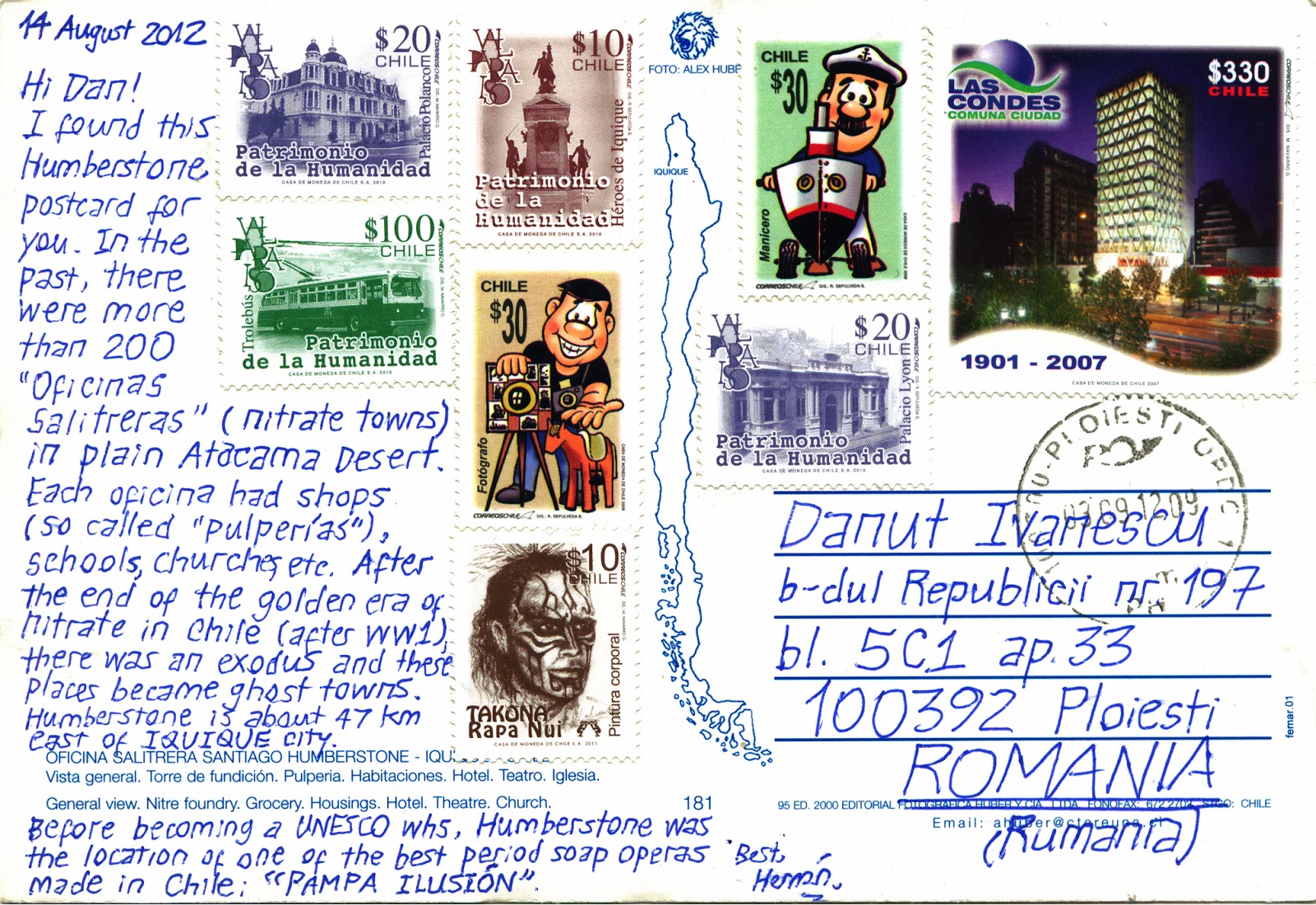
1027 CHILE (Tarapacá) - Humberstone and Santa Laura Saltpeter Works (UNESCO WHS)


The gunpowder is only a simple mix of sulphur, charcoal and saltpeter, but it is known how much it influenced our history. Well, among the three ingredients, the last was the hardest to obtain until the 20th century. Derived as name from the Latin sal petrae (salt of the rock), the saltpeter is a nitrate salt (of calcium, potasium or sodium), used also as fertilizer and food preservative. The calcium nitrate (Norwegian saltpeter) forms an efflorescence where the manure comes in contact with the limestone in a dry environment as in stables or caverns. The potassium nitrate (niter, Chinese snow, or India salpeter) occurs also as a crust on the soil and on the surface of rocks in dry climates and in the soil of limestone caves. Both were therefore rare. In this context, you realize what it meant to Chile and Peru the discovery in the Atacama desert of some deposits of sodium nitrate (nitranite) covering immense areas. The accumulations were so big, that this mineral was named Chile saltpeter or Peru saltpeter.

June 26, 2013

0699 SPAIN (Castile-La Mancha) - Heritage of Mercury. Almadén and Idrija - Almadén (UNESCO WHS)


Mercury is a relatively rare metal, with a decisive role in the extraction of silver and gold, so the possesion of the mercury mines had a worldwide strategic importance. Until recent times, it has been produced in substantial quantities and over a long period only by a small number of mines, of which the biggest were at Almadén in Spain and Idrija in Slovenia. These two mining towns was included on the UNESCO World Heritage Sites list in 2012, because this dual testimony is unique, and it illustrates the various industrial, territorial, urban and social elements of a specific sociotechnical system.

September 16, 2012

0333 CHILE (Libertador General Bernardo O'Higgins) - Sewell Mining Town (UNESCO WHS)


Situated in the Andes, on volcano Cerro Negro, at about 2100m high, 80km from Santiago and 60km to the east of Rancagua, in an environment marked by extremes of climate, Sewell is the site of the world’s largest underground mine, with about 1500km of galleries. Built by the Braden Copper company in 1905 to house workers at copper mine El Teniente, is, according to UNESCO, which designated it in 2006 a World Heritage Site, under the name Sewell Mining Town, "an outstanding example of the company towns that were born in many remote parts of the world from the fusion of local labour and resources from an industrialized nation, to mine and process high-value natural resources. The town was built on a terrain too steep for wheeled vehicles around a large central staircase rising from the railway station".