Showing posts with label trains. Show all posts

January 11, 2020

3349 SAINT KITTS AND NEVIS - Saint Kitts Scenic Railway Tour


Saint Kitts Scenic Railway is an 29 km long narrow gauge railway line along the coastline of the island of Saint Kitts, with a track gauge of 762 mm, promoted especially in the colonies of the British Empire during the second half of the 19th century. The original track was laid from 1912 to 1926, to deliver sugar cane from the plantations to the new centralised sugar mill in Basseterre. Now, the last railway in the West Indies provides a fascinating way for visitors to see the island from the comfort of modern passenger train cars and sightseeing buses.

November 30, 2019

3273 ROMANIA - Second Train Postcrossing Meetup, Bucharest-Ploieşti, 24 February 2018

3273 The third postcard of the series
"100 years since the Great Union of Romania" (3/12)
- The electric-diesel locomotive 92 53 0 641179-2

The third meeting of the Romanian postcrossers in the year of the Centenary of the Great Union took place on February 24, 2018, and was actually the second train Postcrossing meetup between Bucharest and Ploieşti (the first took place on February 29, 2016). On the postcard is the 6-axis electric-diesel locomotive 92 53 0 641179-2 (GM 1179), considered the most beautiful locomotive of the Sibiu depot, and nicknamed the Blue Fury.

December 14, 2017

1406, 3217 ROMANIA (Maramureş) - Vaser Valley Mocăniţa

1406 CFF Vişeu de Sus - Locomotive 764.421 Elveţia (Switzerland),
in Valea Scradei, on July 15, 2008.

Posted on 11.01.2015, 14.12.2017
A mocăniţă is a narrow gauge railway in Romania (most notably in mountainous areas in  Maramureş, Transylvania, and Bukovina), and the locomotives operating on them. The word is a term of endearment, derived from mocan (meaning shepherd or one who lives in the mountains), and suffixed as feminine and diminutive. Many of these forestry railways were built in the era of the Austro-Hungarian Empire, especially in the Carpathians. They followed the rivers, often necessitating tight curves, and the tracks were constructed so as to enable small locomotives to pull empty logging wagons up into the mountains and to let heavily loaded trains roll down under gravity to the saw mills.

3217 CFF Vişeu de Sus - Locomotive 764.435 Bavaria

The most well-known mocăniţă runs in the Vaser Valley in Maramureş County, in the far north of Romania, close to the border with Ukraine. CFF Vişeu de Sus (CFF is the abbreviation for Căile Ferate Forestiere, meaning Forestry Railway) is the last remaining forestry railway in Europe. The industrial use of timber in the Vaser Valley began in the 18th century, during the Austro-Hungarian Empire. German-speaking settlers explored the forest, harvested the timber, and transported it in log rafts down the river to the saw mills of Vişeu de Sus.

October 9, 2017

3166 POLAND (Greater Poland) - Pleszew Narrow Gauge Railway


Pleszew is a town located about 90 km southeast of Poznań. The 3km narrow gauge line from Pleszew Miasto (town) station to Pleszew Wąsk (narrow gauge) station (adjacent to Pleszew main line station in the village of Kowalew), is the surviving fragment of the 750mm gauge Krotoszyn District Railway, which ran from Krotoszyn to Broniszewice, via Pleszew (50km). This line (formally named the Krotoszynska Kolej Dojazdowa) dates back to 1900.

August 24, 2017

3134 SWITZERLAND (Ticino) - The Monte Brè funicular and Lake Lugano


Lake Lugano, named after the city of Lugano, is a glacial lake which is situated on the border between southern Switzerland and northern Italy. Well-known mountains and tourist destinations on the shores of the lake are Monte Brè to the east, Monte San Salvatore west of Lugano, and Monte Generoso on the south-east shore. The lake is 48.7km2 in size, 63% of which is in Switzerland and 37% in Italy, has an average width of roughly 1km, a maximum depth of 288m  found in the northern basin.

August 18, 2017

2579, 3128 THAILAND (Prachuap Khiri Khan) - Hua Hin Railway Station

2579 Hua Hin Railway Station (1)

Posted on 28.05.2016, 18.08.2017
Hua Hin Railway Station is one of the most important stations on the Southern Line, the longest railway line in Thailand. The Southern Line third phase between Cha-am Station to Hua Hin was opened in November 1911, and the line continued to Wang Phong Station in January 1914. The original station building was built in 1910, and rebuilt in 1926, by Prince Purachatra Jayakara (former commander of the Royal State Railways of Siam) to the current Victorian building today.

3128 Hua Hin Railway Station (2)

Hua Hin's popularity began to increase in the 1920's, when King Rama VI built Klai Kang Won Palace as a summer retreat. Hua Hin station is one of the most beautiful and one of the oldest in Thailand. The design was taken from the planned Siam Rat Museum Expo, intended to be built in 1925 at Lumphini Park, but was never built due to the death of King Vajiravudh and the cancellation of the expo by King Prajadhipok.

May 26, 2017

3068 INDIA (Tamil Nadu) - Nilgiri Mountain Railway - part of Mountain Railways of India (UNESCO WHS)


The development of railways in the 19th century had a profound influence on social and economic developments in many parts of the world. The Mountain Railways of India are examples of hill railways which exhibit an important cultural and technologicaly transfer in the colonial setting of the period of its construction. Opened between 1881 and 1908, and still fully operational, they applied bold and ingenious engineering solutions to the problem of establishing an rail link across a mountainous terrain of great beauty.

December 19, 2016

2909 MALAYSIA - KTM Komuter Class 92 EMU


KTM Komuter is a commuter rail service brand operated by Keretapi Tanah Melayu (KTM), the main rail operator in Peninsular Malaysia. It was introduced in 1995 to provide local rail services in Kuala Lumpur and the surrounding Klang Valley suburban areas, and in 2015 in the states of Kedah, Perak and Pulau Pinang, but also between Seremban and Gemas in Negeri Sembilan. The trains used are air-conditioned electric multiple units. The original Komuter rolling stock consists of three versions of three-car EMUs added over the course of three years, beginning in 1994.

December 11, 2016

2897 MALAYSIA (Sabah) - Vulcan Steam Locomotive in Sabah


The 1880's had brought about a great change in Borneo under the British Government. With the establishment of the British North Borneo Company, the so-called 'White Rajahs' as known by locals, were enabled to obtain parts of North Borneo from the Sultan of Sulu. Soon, experimental land cultivation for coffee, coconuts, tobacco, ramin and cocoa received full support from the Company and this prompted the development of better infrastructure facilities.

October 6, 2016

2802 UNITED STATES (New York) - Line 7 of New York City Subway

2802 New York City Subway - A train made up of R62As cars in 7
service entering Queensboro Plaza, bound for Flushing-Main Street
New York City -Empire State Building

Within the nomenclature of the subway, the "line" describes the physical railroad track or series of tracks that a train "route" uses on its way from one terminal to another. In the subway system of New York City, "routes" (also called "services") are distinguished by a letter or a number and "lines" have names. In this system, there are 24 train services. Each route has a color and a local or express designation representing the Manhattan trunk line of the particular service.

September 30, 2016

2786 FRANCE (Auvergne-Rhône-Alpes) - Chemin de Fer de La Mure


The Chemin de Fer de La Mure (La Mure railway) is a former coal-carrying electrified railway in (and owned by) the Department of Isère near the city of Grenoble, which lost its regular public passenger service in 1950 (although miners' trains continued until 1962). It lost most of its freight traffic in 1952, and even the anthracite ceased in 1988. However, the local tourist office had been chartering seasonal tourist passenger trains since 1968 and these developed steadily over the years, the line becoming one of the finest tourist railways in Europe with spectacular views over dams and lakes, and mountain scenery.

September 27, 2016

2779 HUNGARY - The locomotive no. 376.631, class 376


During the last two decades of the 19th century the number of branchlines in Hungary increased quickly, almost all of them as private initiatives. The builders made use of the state grants and real estate speculations, but when getting ready, they left the operation for the State Railway, MÁV. This happened usually using the "Standard Contract", which foresaw all parts of the railroad to be built according MÁV standards. The most branchline companies built on the cheapest way that was allowed by the "Standard Contract", resulting light rails capable only for axle loads as light as 10 metric tons.

September 16, 2016

2756 HUNGARY - Siemens Taurus electric locomotive No. 470 007


At the beginning of the 1990's, Deutsche Bahn AG wanted to replace the aged Einheits-Elektrolokomotiven (standard electric locomotive) with a more modern and efficient model. So appeared the EuroSprinter family of electric locomotives, a modular concept of locomotives for the European market built by Siemens. The internal Siemens product name is ES 64, with ES for EuroSprinter and the number 64 indicating the 6,400 kW power at rail. Additional information is given in the name on the usage (U as universal, P as prototype and F as freight).

May 7, 2016

2528 UNITED STATES - A 4-4-0 locomotive of Union Pacific Railroad


The Union Pacific Railroad network is the largest in the United States and also one of the world's largest transportation companies. The company extended the American railway system to the Pacific Coast; being incorporated by an act of the U.S. Congress on July 1, 1862. The original rail line was built westward 1,619 km from Omaha, Nebraska, to meet the Central Pacific Railroad line, which was being built eastward from Sacramento, California. The two railroads were joined at Promontory, Utah, on May 10, 1869. Therefore was the first transcontinental railroad.

April 28, 2016

2496 CANADA (Ontario) - Spirit of Windsor


Located on the southern shore of the Detroit River (which flows from Lake St. Clair to Lake Erie), directly across the river from Detroit (Michigan), Windsor is the southernmost city in Canada. It is divided in two by the Ouellette Avenue, its historic main commercial street, which runs north-south, perpendicular to the Detroit River. At the end from the river of the avenue is Dieppe Gardens, one of the 180 parks of the city, in which is resting a Pacific type 4-6-2 steam locomotive named Spirit of Windsor.

April 22, 2016

2481 UNITED STATES (Colorado) - Georgetown Loop Railroad's steam locomotive No. 40 in Colorado Railroad Museum


The Colorado Railroad Museum is located at a point where Clear Creek flows between North and South Table Mountains in Golden, Colorado. It was established in 1959 to preserve a record of Colorado's flamboyant railroad era, particularly the state's pioneering narrow gauge mountain railroads. It has a large collection of 3 ft (914 mm) narrow gauge rolling stock, and provides train rides on "Steam Up days". The museum building is a replica of an 1880s-style railroad depot.

April 14, 2016

2458 UNITED STATES (Georgia) - The Decapod No 208


Under the Whyte notation for the classification of steam locomotives, 2-10-0 represents the wheel arrangement of two leading wheels on one axle, ten powered and coupled driving wheels on five axles, and no trailing wheels. This arrangement, popular mainly in Europe, particularly in Germany and in Russia, was often named Decapod, especially in the United States. Here were built the first such locomotives in 1867, but the first boost in the number of Decapods occurred when Russia ordered approximately 1,200 during WWI.

March 7, 2016

2355 RUSSIA (Kemerovo Oblast) - Locomotive L-112 in Prokopyevsk


Under the Whyte notation for the classification of steam locomotives, 2-10-0 represents the wheel arrangement of two leading wheels on one axle, ten powered and coupled driving wheels on five axles, and no trailing wheels. These locomotives were popular in Europe, particularly in Germany and in Russia. In the former Soviet Union they came from several sources: US imports, German war trophy and locally built. Among the locally built, the L (Lebedyanski) series was one of the more advanced steam locomotives built in the country.

March 5, 2016

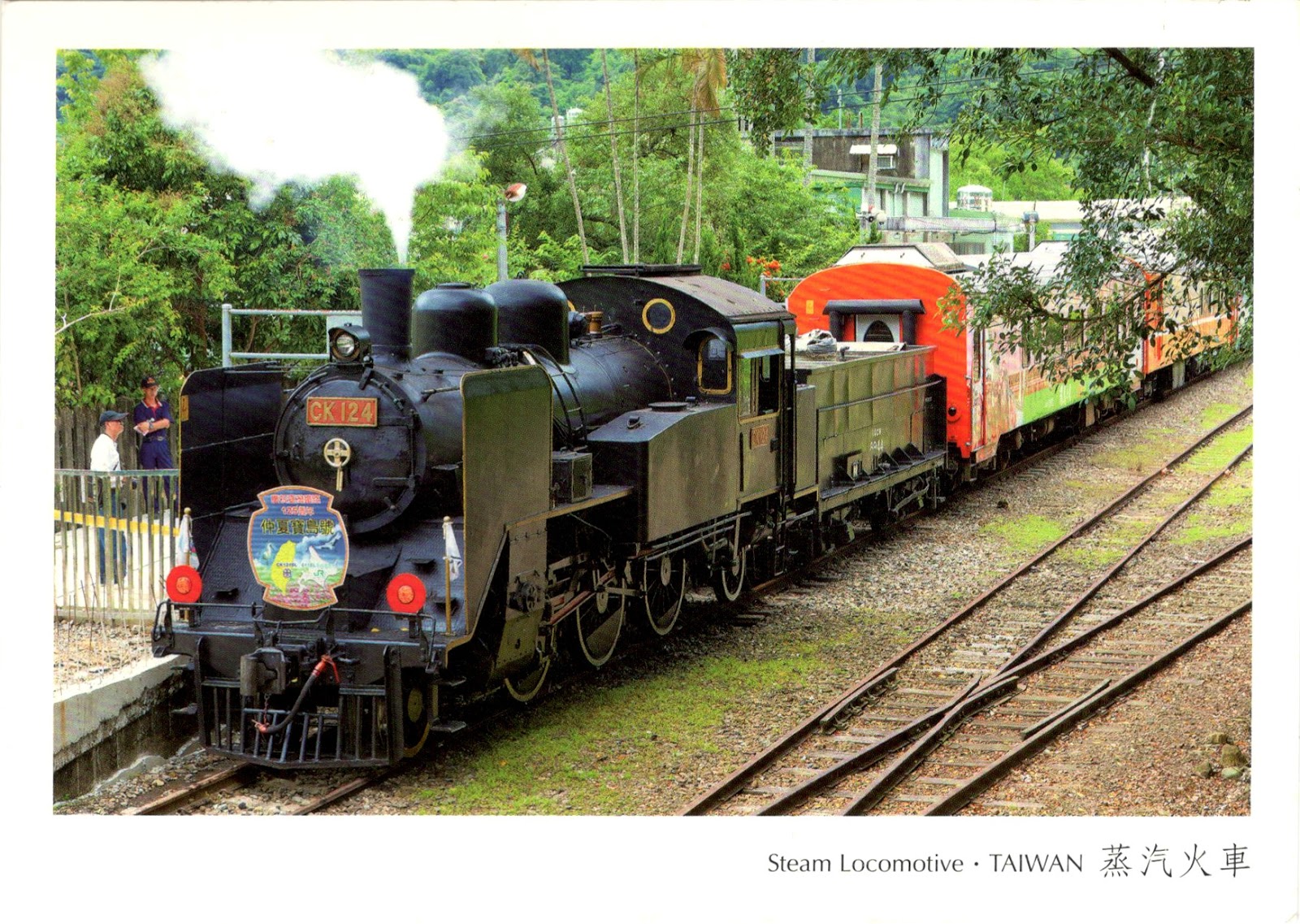
2348 TAIWAN - Locomotive CK124


The first Taiwanese railway was buit during the Qing Era, between 1887 and 1893, but only after two years, Taiwan was ceded to the Empire of Japan. Completely rebuilt and substantially expanded under Japanese colonial government (1895-1945), the Taiwan's railway network inharited the Japanese influence, present even today. Of course that the rolling stock was also mostly Japanese. During the heyday of steam locomotives, more than 200 units coursed Taiwan's plains and mountains.

March 2, 2016

2344, 2775 ROMANIA - The locomotive CFR 230.516


Because the Prussian P 6 steam locomotive, manufactured since 1902, was regarded as unsatisfactory, the railway engineer Robert Garbe designed another one, the Prussian Class P 8, a 4-6-0 locomotive, which will prove a success. Because Garbe was an advocate of the simplest possible designs, a straightforward, superheated steam, two-cylinder driving gear was envisaged. The P 8 benefited from superheated steam technology, which had just been developed by Wilhelm Schmidt (nicknamed 'hot steam Schmidt'), that led to outstanding performance for those times.