Showing posts with label RUSSIA (Novosibirsk Oblast). Show all posts

November 15, 2012

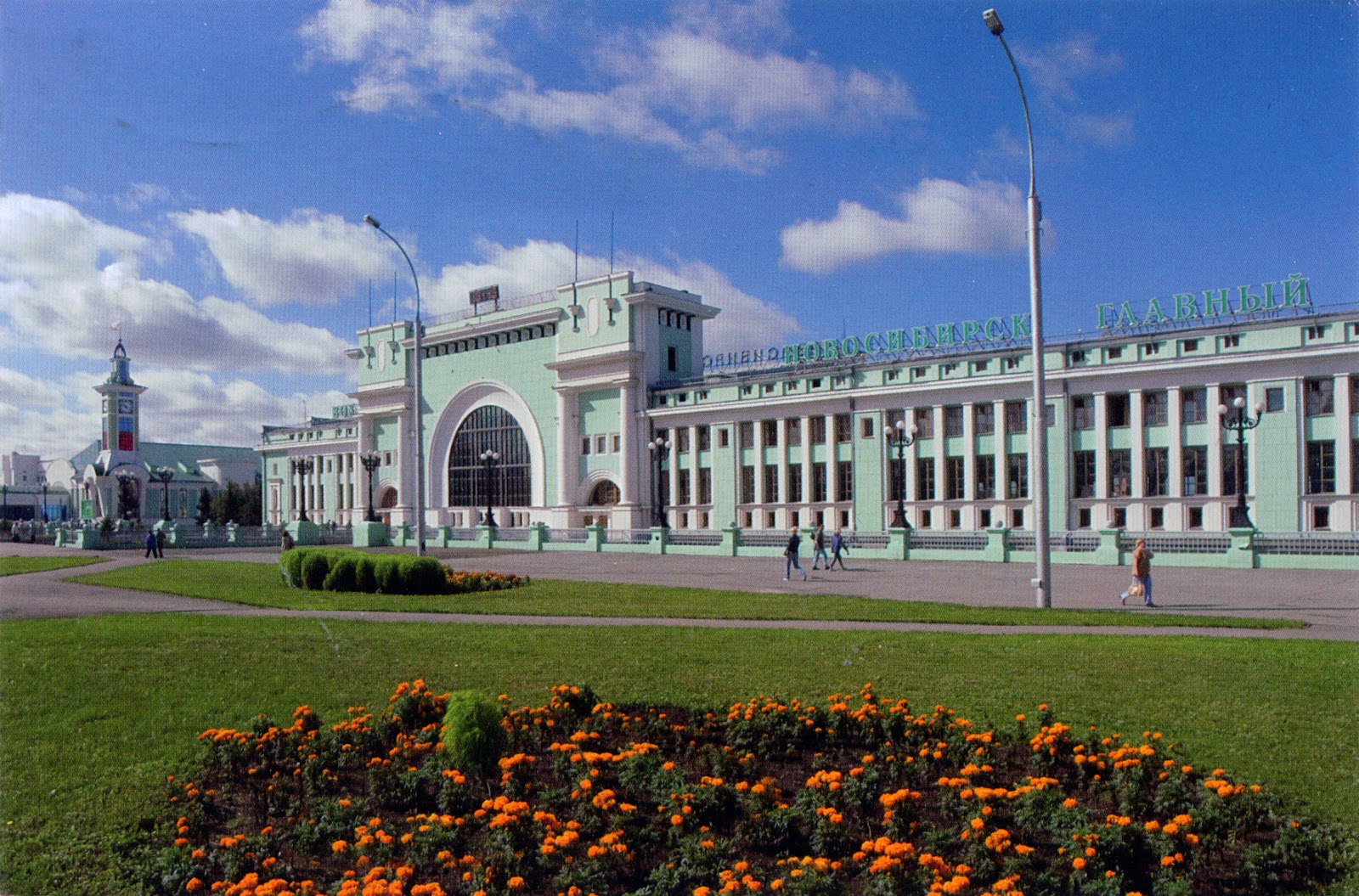
0384-0385 RUSSIA (Novosibirsk Oblast) - The Main Railway Station in Novosibirsk


The third building in Novosibirsk that I want to present you, after Alexander Nevsky Cathedral and Regional Puppet Theatre, is the Trans-Siberian Railway Station, I would say the most important building in town, because the settlement grew around it. Construction of the railway station Ob on the right bank of the Ob River, in the early portion of Middle Trans-Siberian Railway, began in May 1893, and on December 1, 1894 was opened to traffic. Also in 1893 began the work at the bridge over river Ob, which was completed in the spring of 1897, making the new settlement the regional transport hub. Practically it was born as a railway station and it developed due to the bridge. If at the time of the bridge's opening, it hosted a population of 7,800 people, in the pre-revolutionary period the population increased to 80,000, and in 2010 reached 1,473,754 inhabitants.

At the begining, the railway station was a V class one, but in 1897 was built a wooden station III-class lounges, with mail and buffet. In 1906 was attached to it a stone two-storey annexe, and in 1914, another one. Named initialy, as I say, Ob station, in 1909 was renamed Novonikolaevsk, and in 1926 Novosibirsk. In 1929, the Moscow Architectural Society, on behalf of the management of the Omsk Railway, has announced a design competition for the railway station. The first prize was awarded to N. Voloshinov's project, which was concise, in constructivist style. Until the completion, the project has undergone many changes, the unique design of the arch of the central hall being designed by Nikolai Nikitin. The final project of the Central part of the station is a composition of a triumphal arch, framed by Tuscan order pilasters and topped with a large attic. In 1956, the Station Square was renamed in honor of Nikolai.Garin-Mikhailovsky, Russian writer and railroad constructor, involved in the construction of the Trans-Siberian Railway, but also in the founding of Novosibirsk.


The Trans-Siberian Railway, which connect Moscow with the Russian Far East and the Sea of Japan, is the longest railway in the world. At 9,259 kilometres, spanning a record seven time zones and taking eight days to complete the journey, it is also the third-longest single continuous service in the world, after the Moscow–Pyongyang (10,267 km) and the Kiev-Vladivostok (11,085 km) services, both of which also follow the Trans-Siberian for much of their routes.

The Novosibirsk Main Railway Station is the largest station along the Trans-Siberian Railway, and is also the final destination of the Sibirjak express train, the longest train journey originating in the European Union. This weekly train leaves Berlin each Saturday afternoon and arrives Wednesday at lunch time. A travel from Moscow to Novosibirsk costs about 130/270 EUR (upper/lower berth) to the second class, and lasts slightly less than 2 days.

About the stamps
The first postcard
The first two stamps are the moose and the rabbit in the series about animals, about which I wrote here. The third is part of the series XXII Olympic Winter Games in Sochi - Tourism on the Black Sea Coast of Russia, issued on September 27, 2011. These are the most multilingual stamps in the history of the Olympic Winter Games, the information being given in 6 different languages (Russian, English, French, German, Spanish and Chinese). The four stamps shows:

• Krasnaya Polyana (15 RUB)
• the marine passenger terminal (20 RUB) - it's on the postcard
• the watchtower on the Bolshoy Akhun (25 RUB)
• the Volkonsky Dolmen (30 RUB)

The second postcard
The first three stamps are the fox and the bear in the same series about animals, about which I wrote here.


The four stamp, designed by Betredinova K, is a commemorative one, issued on January 22, 2009, with the occasion of the 300th anniversary of foundation of Central Navy museum, one of the oldest museums of Russia and one of the largest naval museums of the world, located in St. Petersburg. 

References
Новосибирск-Главный - Wikipedia
Novosibirsk: Getting There and Around - Way to Russia
Novosibirsk - Wikitravel
Travel to Novosibirsk by Trans-Siberian Railway - Russian communication courses in Russia
“Sochi 2014” Olympic Stamps Will Be Available on Subscription - Soch 2014 official site
The 300th anniversary of foundation of Central Navy museum - Rusmarka


sender: Uliana Zolotaryova (direct swap)
sent from Novosibirsk (Russia), on 11.03.2012
photo: A. Kemodyanov

sender: Martynova Svetlana (direct swap)
sent from Novosibirsk (Russia), on 25.03.2012

April 27, 2012

0187 RUSSIA (Novosibirsk Oblast) - Puppet Theatre


If I visit Novosibirsk, I wouldn't rush to see neither the colossal sculpture of Lenin or State Academic Opera and Ballet Theatre, nor the Church of Saint Nicholas or Alexander Nevsky Cathedral, although certainly every of them worth seeing. First and foremost I would like to get on Prospekt Lenina 22, where is the Regional Puppet Theatre, the building from the postcard.

Founded on the 1st of September 1933 as a studio of puppeteers of the Novosibirsk Theatre of Young Spectator, it hosted the first season of theatrical performance in the spring of 1934. More accurate the first performance took place on May 1, 1934, so over very few days will be fulfilled 78 years since than. During the period from 1942 to 1945, the theatre housed the Moscow Puppet Theatre, evacuated to Novosibirsk.

Today the theatre is situated in the annex to the building of the former city college, an historical building, one of the earliest works of A. Kryatchkov, which preserved in nowadays its original aspect. The annex was built in 1999 to the eastern façade, which has the form of three tilting dolls, with reference to national toy, skomorokh performances, Russian balagan and fairytale. A. Mihailov has projected the theatre and I. Elchenko made pictures of the stained glasses. The theatre has a puppet show, cafe, fairytales’ room and playing room.

The first two stamps are the moose and the rabbit in the series about animals, of which I also received the fox (details here). The last one is a thematic stamp for the New Year 2011, issued on December 1.


sender: Uliana Zolotaryova (direct swap)
sent from Novosibirsk (Russia), on 18.04.2012
photo: A. Kemodyanov

April 15, 2012

0173 RUSSIA (Novosibirsk Oblast) - An Alexander Nevsky Cathedral in the heart of Siberia


Today celebrate Easter (the Resurrection of Jesus, Son of God) over 300 million Orthodox Christians worldwide, primarily in Belarus, Bulgaria, Cyprus, Georgia, Greece, Macedonia, Moldova, Montenegro, Romania, Russia, Serbia and Ukraine (the order is alphabetical), but also in many other countries in the world where inhabit smaller communities. Most live in Russia, where over 70% of the population is Christian Orthodox (nearly 100 million). So my choice for today was stopped on a church in Russia, but not on the old one from the European Russia, as would be expected, but on a new one, located in Siberia, more precisely in Novosibirsk.

Founded in 1893 at the future site of a Trans-Siberian Railway bridge crossing the river Ob, Novosibirsk (initially named Novonikolayevsk, in honor of both Saint Nicholas and the reigning Tsar Nicholas II) is today the third most populous city in Russia, after Moscow and Saint Petersburg. Rapid growth and industrialization has brought to the city the nickname "Chicago of Siberia".

One of the first stone constructions in Novonikolayevsk was Alexander Nevsky church, built in 1896-1899 in Neo-Byzantine style, influenced by the design of Church of Our Lady the Merciful in St.Petersburg, erected a few years earlier. In 1915 it became a cathedral, but in 1937 it was closed, and in 1989 was restituted to the Russian Orthodox Church.

Even if the church was built after the death of Tsar Alexander III (r. 1881-1894), she greatly respected his taste. Nearly all of the 5,000 churches attributed to this tzar belonged to the late 19th century variant of Russian Revival, as a reaction against to 18th century baroque and neoclassicism, to which he displayed a clear aversion. Indeed, Byzantine architecture isn’t Russian Revival, but was an acceptable "middle road".
  
The patron saint, Alexander Nevsky (1220-1263) was, as the Prince of Novgorod and Grand Prince of Vladimir, a key figure of medieval Rus, being proclaimed Saint of the Russian Orthodox Church in 1547. For his military victories over the German, and Swedish invaders, is regarded as patron saint of soldier and borders of Russia. Probably not incidentally was chosen as patron saint to many cathedrals located (outside those of capitals Moskow and Saint Petersburg) to the edge of the empire, such as the ones from Baku (Azerbaijan), Łódź and Warsaw (Poland), Tallinn (Estonia), Tiflis (Georgia), Kamianets-Podilskyi and Yalta (Ukraine), or even beyond, in Belgrade (Serbia), Sofia (Bulgaria) or Prešov (Slovakia).

As you can see, the stamp doesn't exist, because this postcard isn't a postcard in the true sense, because you can't write on it and can be shipped only in envelope. And only to the Russian speakers. On the back is a brief history of the cathedral (on left) and a list of the icons which are inside the church (on right).
 

sender: Svetlana Martynova (direct swap)
sent from Novosibirsk (Russia), on 25.03.2012